All,
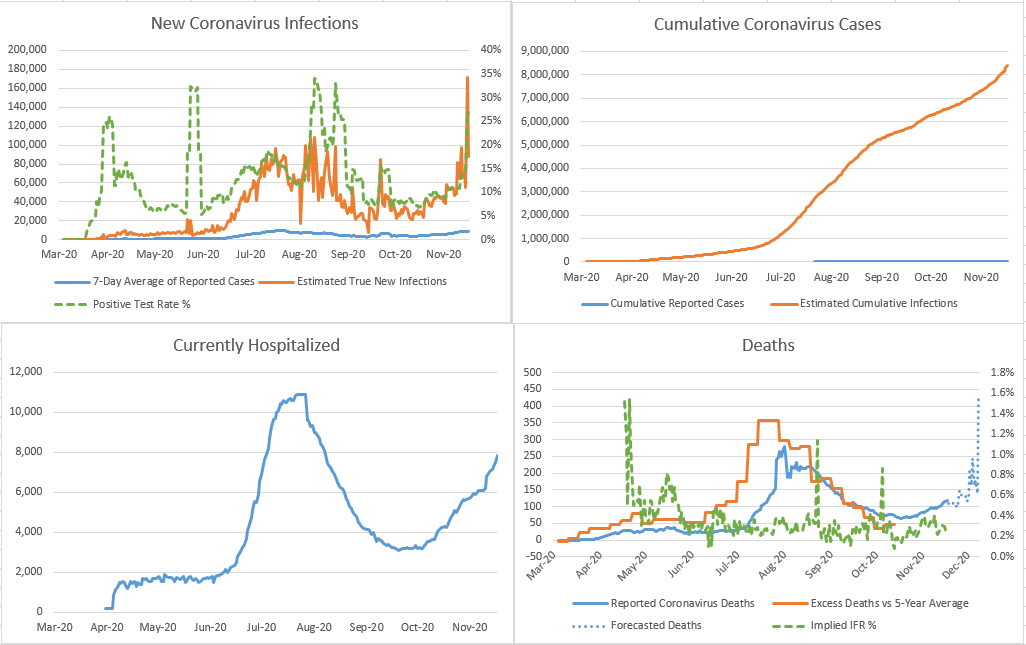
I have been unhappy with the different ways that the data is presented on coronavirus after Youyang Gu stopped updating his model. I wanted someone to not just present cases, but also true infections. I wanted someone not to report deaths but IFR.
I went ahead and did the work myself, based on Youyang Gu's methodologies for estimating true infections, which has been pretty good and approximated by other epidemiologists:

I hope you guys find it useful, interesting.
Notes:
1. True infections estimated by Youyang Gu's methodology
https://covid19-projections.com/estimating-true-infections/
2. Rest of reported case, hospitalization, death data from COVID tracking project
3. Excess mortality data from CDC. I subtracted the excess mortality of this year versus the average of the last 5 years in order to calculate the excess mortality.
https://gis.cdc.gov/grasp/fluview/mortality.html
4. Updated excess mortality graph below. The different shades indicate different times I have updated this graph and published to Texags.

5. I used a 22 day delay to calculate implied IFR, consistent with what I've seen epidemiologists like Trevor Bedford discuss.
6. I used reported, not excess deaths for the ifr calculation.
7. Forecasted deaths just uses that 22 day delay from infections and projects forward deaths based on 0.25% ifr
I have been unhappy with the different ways that the data is presented on coronavirus after Youyang Gu stopped updating his model. I wanted someone to not just present cases, but also true infections. I wanted someone not to report deaths but IFR.
I went ahead and did the work myself, based on Youyang Gu's methodologies for estimating true infections, which has been pretty good and approximated by other epidemiologists:
I hope you guys find it useful, interesting.
Notes:
1. True infections estimated by Youyang Gu's methodology
https://covid19-projections.com/estimating-true-infections/
2. Rest of reported case, hospitalization, death data from COVID tracking project
3. Excess mortality data from CDC. I subtracted the excess mortality of this year versus the average of the last 5 years in order to calculate the excess mortality.
https://gis.cdc.gov/grasp/fluview/mortality.html
4. Updated excess mortality graph below. The different shades indicate different times I have updated this graph and published to Texags.
5. I used a 22 day delay to calculate implied IFR, consistent with what I've seen epidemiologists like Trevor Bedford discuss.
6. I used reported, not excess deaths for the ifr calculation.
7. Forecasted deaths just uses that 22 day delay from infections and projects forward deaths based on 0.25% ifr