
I've seen 3.5% of cases diagnosed 7 days prior as a national average with that number falling as hospital capacity drops.
Post Reply
1 of 1
Hospitalization Rates
3,079 Views |
14 Replies |
Last: 5 yr ago by Not a Bot
No, people that understand medicine and health understand that there is more to a disease than simply death rate. What is the death rate was zero but it left half the infected with some level of paralysis, or permanent lung scarring. Or, like you point out what if the hospitalization rate was significantly higher, and we run out of space for the car accidents or the heart attacks? What if doctors and nurses just say " screw it, I'm out.".
So yeah, you're correct, morbidity is just as important as mortality. And hospitalization rate is also high up there on importance.
So yeah, you're correct, morbidity is just as important as mortality. And hospitalization rate is also high up there on importance.
I dont have time to dig in but I think these sites from the cdc may have data you may be interested in:
Covid: https://www.cdc.gov/coronavirus/2019-ncov/covid-data/covidview/index.html
Influenza: https://www.cdc.gov/flu/about/burden/2019-2020.html#:~:text=CDC%20estimates%20that%20the%20burden,flu%20deaths%20(Table%201).
Covid: https://www.cdc.gov/coronavirus/2019-ncov/covid-data/covidview/index.html
Influenza: https://www.cdc.gov/flu/about/burden/2019-2020.html#:~:text=CDC%20estimates%20that%20the%20burden,flu%20deaths%20(Table%201).
The hospitalization data is easy enough to find on https://covidtracking.com/, but I see the issue is that this shows occupancy, not necessarily total number of people hospitalized.
I suppose in Houston you could drill down to the total hospitalzed number by adding up the "new hospitalized" dataset.
You could estimate total infected people by using a well-regarded model like this:
https://covid19-projections.com/
I suppose in Houston you could drill down to the total hospitalzed number by adding up the "new hospitalized" dataset.
You could estimate total infected people by using a well-regarded model like this:
https://covid19-projections.com/
Finally a discussion beyond the simpleton "you're not going to die" point of view.
I am no doc, but I would imagine it has to due with the population of each state . . . .prevelence of obesity, comorbidities, income stratification, etc.Quote:
For the docs on here, any idea why the wide range of hospitalization rates from state to state?
Those groups tend to have harder illnesses. Alabama vs New Hampshire does not surprise me in that regard.
Well . . .docs usually aren't the people that sort those issues out. Epidemiologists are the folks that make such claims.
And I would say that worldometer data has been found to be very buggy.
And I would say that worldometer data has been found to be very buggy.
I think you will find there is no one answer your question and probably not even a good or useful one. If you still want to go really deep go to the state level projection, look at the various links at the CDC Website here:
https://www.cdc.gov/coronavirus/2019-ncov/cases-updates/hospitalizations-forecasts.html
You will see the different modeling assumptions from Columbia, Johns Hopkins, Los Alamos, you name it.
There are tons of factors to consider including different vaccination policies, different social distancing attitudes, different climates, different population densities, different testing capabilities, different income levels, different obesity levels, etc. etc.
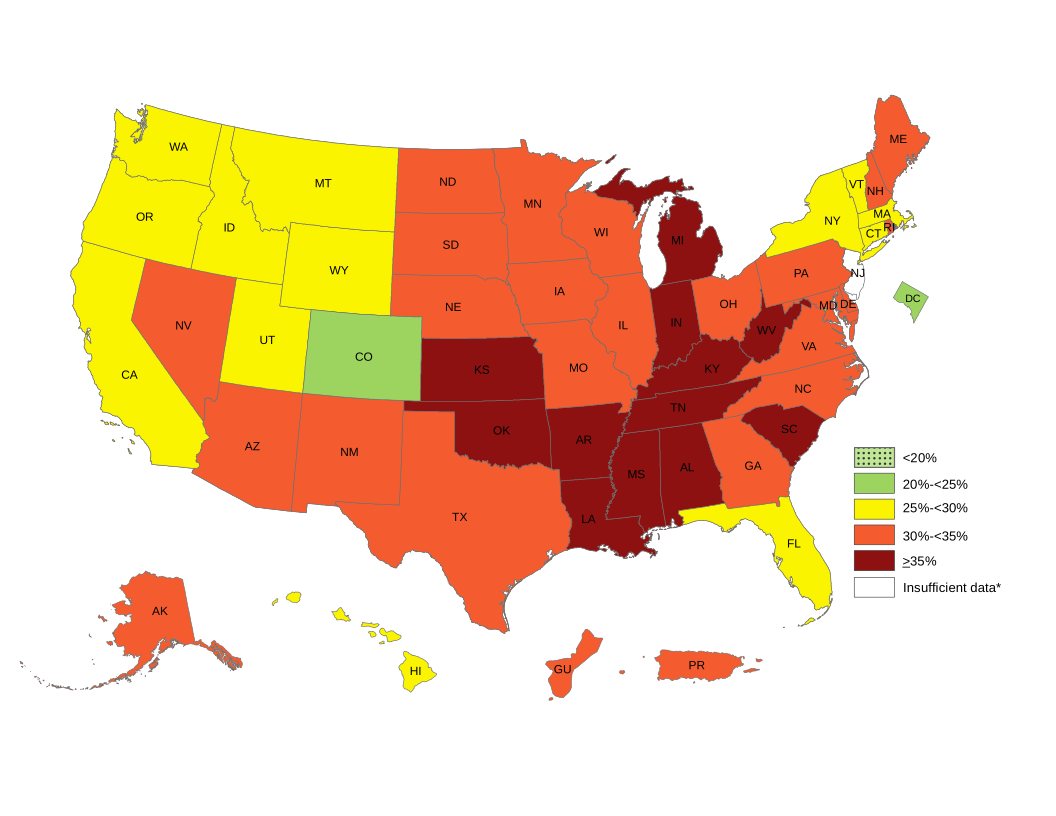
Some of the correlations are more obvious . . .obesity for instance. Bama has one of the highest rates in the country at 36% of the population. That alone doesnt explain it all and why right now versus not before of course.
https://www.cdc.gov/coronavirus/2019-ncov/cases-updates/hospitalizations-forecasts.html
You will see the different modeling assumptions from Columbia, Johns Hopkins, Los Alamos, you name it.
There are tons of factors to consider including different vaccination policies, different social distancing attitudes, different climates, different population densities, different testing capabilities, different income levels, different obesity levels, etc. etc.
Some of the correlations are more obvious . . .obesity for instance. Bama has one of the highest rates in the country at 36% of the population. That alone doesnt explain it all and why right now versus not before of course.
I think I just figured it out.
It is clearly spreading through the tributaries of the Mississippi River.
Someone get me on the line with the President!
It is clearly spreading through the tributaries of the Mississippi River.
Someone get me on the line with the President!
Featured Stories
See All
Belief leads Earley to start Sdao in regional opener
by Richard Zane
Prophetic Sankey closes SEC Spring Meetings without CFP resolution
by Olin Buchanan
11:36
8h ago
2.4k
Alberts welcomes the potential of bipartisan legislation
by Olin Buchanan
24-team CFP would threaten conference title games
by Olin Buchanan