
Virus transmission

2,077 Views | 14 Replies | Last: 5 yr ago by TXTransplant
TXTransplant
How long do you want to ignore this user?
I have a specific question for medical/health experts about how viruses are spread, specifically with respect to people who have antibodies.

I know people can be infected, be asymptomatic, and still spread the virus to others. That makes sense. Even if you are asymptomatic, if you are infected, the virus is living and replicating in your body. Your body is making virus particles, and you are shedding them through your nose, mouth, etc.

However, can someone who has antibodies (either through a previous infection or from vaccination) be a "carrier" of the virus and spread or to others? By "carrier", I mean this person does not become (re)infected, but still spreads virus particles and can infect others?

I'm obviously asking this in the context of Covid-19, but it should apply to other viruses like the flu, measles, and the common cold.

To spread a virus, you have to have a high enough viral load to cause the virus to replicate inside your body. That's what generates the virus particles that get spread around.

Is it really feasible for a person with antibodies to inhale some virus particles, exhale those same particles, and infect someone else without ever becoming infected him/herself?

This scenario just seems to defy all logic when it comes to antibodies and immunity.

Are there any examples of a vaccinated person spreading something like polio or measles?

I know the verdict is still out on C-19, but why would it behave differently in this respect than any other virus?

The idea that you can catch a virus from someone who is not infected (because they have antibodies) just doesn't make sense to me, but I'm completely open to learning more if my understanding is wrong.
Post removed:
by user
TXTransplant
How long do you want to ignore this user?
AstroAg17 said:

Having detectable antibodies don't necessarily mean you're not infected or that you're immune from infection. The concentration of antibodies in your system is very important in determining the level of antibody-mediated protection you will have. Coronavirus has a large T-cell mediated component to immunity as well that needs to be considered.


Understood. But it's accepted that other vaccines provide adequate immunity - some for life just after one vaccination, others yearly. We don't worry that vaccinated people will spread measles or polio if they come into contact with an unvaccinated/infected person.

So, how is it determined how often the vaccine needs to be administered and/or how long it will last. Is that part of long-term studies.
Post removed:
by user
TXTransplant
How long do you want to ignore this user?
Thanks for the clarification - especially the last sentence.

It makes sense that there might be some concern that vaccinated people could still become infected, especially since we know re-infections are possible. And, like with the flu, the vaccine isn't expected to prevent ALL infections.

However, since I tested positive, it's the "carrier" scenario that people I talk to keep bringing up. Several have tried to tell me that you can still spread the virus to others even if you have active antibodies. And, I'm hearing media snippets that are promoting the idea that vaccinated people will still be able to "spread" the virus.

While I'm not saying that's impossible, it doesn't seem like a scenario that we should be really concerned about. Is it possible? Sure...but I have a hard time believing that it's probable/likely.

I've been thinking about this a lot because, even though I was infected last month, some people believe I still need to wear a mask. Now, I know I won't have antibodies/immunity forever, but I was literally told this by someone within days after my recovery. Basically, this person did not seem to believe that there is any time period where I can't spread the virus.

I do wear a mask, because it's required at work and most places I go, but this idea that people with active antibodies (or who have been vaccinated) can spread this (without being infected themselves) just seems like fear-mongering.

And the idea of still having to wear a mask and socially distance AFTER a significant portion of the population is vaccinated just really flies in the face of science - or at least what I understand of virus transmission and vaccinations.

If I'm wrong, I definitely want to be corrected.
Ranger222
How long do you want to ignore this user?
AG
TXTransplant said:

I do wear a mask, because it's required at work and most places I go, but this idea that people with active antibodies (or who have been vaccinated) can spread this just seems like fear-mongering.

You are missing one very major point on antibody production against pathogens. Your body does not constantly make antibodies against all pathogens you have encountered over the course of your life. Think about all the times you have gotten sick or all the pathogens you may have come across over the course of your life that never led to disease -- that would be a lot of antibodies for your body to constantly make as you age. Instead, antibody titers against any specific pathogen decrease over time after you have had an active infection, since the pathogen is no longer around until you encounter it again. Some antibody producing cells (called B Cells) that have memory to produce antibodies against a specific pathogen will hang around throughout your life -- but they are not making active antibodies. They have to be stimulated to go into action. Like a firefighter waiting for an emergency call. There may also not be a lot of them...just a few. They have to reproduce after stimulation to make more of themselves to produce enough antibody to fight infection. Thus, it takes time to make enough antibodies to efficiently neutralize the threat. There is a "time delay" to making enough antibody after you encounter a pathogen you have memory for.

So when it comes to mask wearing and SARS-COV-2 : if you are vaccinated, and become infected with SARS-COV-2, its a race between the virus and your body for making antibodies. The virus is going to replicate within your nasal tissue while the body is stimulating those memory B cells and the B cells are trying to increase in number to make enough antibody to neutralize the virus. Until SARS-COV-2 specific antibody titers are high enough to neutralize all virus, you WILL have virus replication and COULD spread it to others.

The issue is we don't have enough data right now to understand who will win this specific race -- your adaptive immunity with B cells and anitbodies or the virus replicating. We just haven't done the studies (and really there is no great model experiment we could do to really answer this question). We can try and make generalizations with what we know with other pathogens, but SARS-COV-2 is a unique pathogen and we just can't say for sure.

So in short you don't always have active antibodies hanging around even after vaccination so you wouldn't be able to effectively neutralize the virus before it replicates in you and you could spread it to others.
Ranger222
How long do you want to ignore this user?
AG
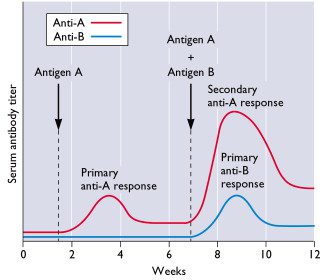
Here is a helpful figure to understand antibody titer after infection or "challenge" from a virus.

You'll see that while you do get an antibody response, it wanes over time until there is another infection or challenge, and then it too wanes over time.

This also shows why your booster for vaccination is important -- the antibody response is stronger after a second challenge than only one.

Post removed:
by user
TXTransplant
How long do you want to ignore this user?
Everything you've said makes sense, but it's your last paragraph that's really what I'm focused on right now.

From a scientific standpoint, I know it's possible that a vaccinated person (or a recently infected and recovered person) could be exposed to a virus, inhale live virus, exhale live virus, and infect someone else. The explanation you gave about it being a race between the virus and our immune system is very good.

But (as I pointed out in another thread) what is possible vs what is probable.

No offense to any doctors or medical researchers here, but the field in general does a terrible job distinguishing between the two.

I'm to the point where I'm ready to hear medical professionals talk about when masks and social distancing will no longer be required. I think making statements like "Well, this virus is new and we don't have the data, yet, so we have no idea when we can stop wearing masks" is really damaging to the situation, especially because it gives the anti-vaccine crowd yet another reason/excuse to avoid getting the vaccine.

I'm a scientist myself (chemicals, not medicine), so I know there is a fine line between being too optimistic and not putting enough cautious awareness in people to get them to take precations. But there is also a fine line between cautious awareness and fear-mongering.

I'm not saying anyone here is fear mongering (we are having a good discussion), but that's exactly why I asked the question in the first place.

I also understand your point re how do we know someone who isn't wearing a mask has been vaccinated (or recently infected). I agree the mask requirement is probably going to hang around for longer than is really necessary for this very reason. There are often non-scientific reasons behind why we are required to do certain things.

But, we have 200 years of vaccine use to support that they are effective. I understand that we are and will be in the "unsteady state" period for this vaccine until a certain number of people get it. But, I'm ready to hear the experts say when they reasonably think we will get to "steady state" and life can return to normal.

This virus is not going away - we have to learn to live with it, not in fear of it.

Maybe this is where my field of science is a little different from yours. I'm an engineer. We collect data, but at some point we have to stop collecting data and extrapolate trends and build models based on the data we have. We know there are outliers, but we tend to categorize them as "statistically insignificant" (and not likely to occur). We certainly don't focus on the outliers as potential outcomes.

It seems like the medical/health fields put more focus on these outliers (whether possible or proven), and are more reluctant to draw conclusions because of them. Probably because they often mean the difference between life and death.

In turn, society has started focusing on these outliers, giving them more attention, and making average lay people more fearful of them because they hear about them so often. We are falsely (intentionally or unintentionally) led to believe that these outliers are more common than they are.
Post removed:
by user
Post removed:
by user
TXTransplant
How long do you want to ignore this user?
I appreciate the points about extrapolating from other vaccines. Based on your comments, I was giving that potential too much weight.

As far as the communication issues go, I totally agree. When I was teaching, I tried to incorporate some very basic principles of statistics into a lab class. The resistance I got was mind-boggling - and this was from engineering students.

And I can appreciate that communicating science, data, and technical information is difficult. My industry/field struggles with it. But, the information we are trying to share isn't life or death, nor does it affect how people live their every day lives.

I am concerned that we've set a really bad precedent with our response to this whole situation. I keep hearing people say "listen to the science", but even that's not really correct. Science has all sorts of crazy outliers and outcomes.

You have to listen to the data and what the statistical analysis of that data tells you.

I'm also a big proponent of risk assessment (it's huge in my industry), but when it comes to health and life/death, we seem to have zero tolerance or acceptance of risk and/or negative outcomes. I don't get the impression that risk assessment plays as much of a role in medicine as it does in my field.
TXTransplant
How long do you want to ignore this user?
AstroAg17 said:

Let's take as an example the carrier situation you describe in the OP. Is it possible for me to inhale virus particles, then later exhale that same particle and infect someone? Sure. It's conceivable. But I bet you, with no data to back it up, that that is a negligible transmission route. I won't say it's impossible, but I think we can safely say we don't need to worry about it.

I think the refusal to speak in certainties confuses people to some degree.


I totally agree with this. It's basically the point I've been trying to make all along. You just did it much more succinctly! And, obviously have the technical background to back it up (I was just making an educated guess).

And, as we've already said, the media (and people, too), like to focus on the worst-case scenarios, no matter how unlikely or improbable they are.
Post removed:
by user
BlackGoldAg2011
How long do you want to ignore this user?
AG
TXTransplant said:

I appreciate the points about extrapolating from other vaccines. Based on your comments, I was giving that potential too much weight.

As far as the communication issues go, I totally agree. When I was teaching, I tried to incorporate some very basic principles of statistics into a lab class. The resistance I got was mind-boggling - and this was from engineering students.

And I can appreciate that communicating science, data, and technical information is difficult. My industry/field struggles with it. But, the information we are trying to share isn't life or death, nor does it affect how people live their every day lives.

I am concerned that we've set a really bad precedent with our response to this whole situation. I keep hearing people say "listen to the science", but even that's not really correct. Science has all sorts of crazy outliers and outcomes.

You have to listen to the data and what the statistical analysis of that data tells you.

I'm also a big proponent of risk assessment (it's huge in my industry), but when it comes to health and life/death, we seem to have zero tolerance or acceptance of risk and/or negative outcomes. I don't get the impression that risk assessment plays as much of a role in medicine as it does in my field.
This part is a major issue in communicating all of this information to the public. Statistics is well beyond most people's grasp of mathematics. It's a complex field and is also really easy to be intentionally misleading with. Also the part about "listen to the science" gets me too, because i normally hear it from people who don't understand the science they are trying to listen to. also science may tell us all about a virus, but is totally incapable of informing a nation on what the proper balance between protecting the public health and protecting the economy is. That requires a lot more fields than virology/epidemiology/immunology to be involved.

Also, as an engineer myself, I often lose sight of the fact that medicine has the pesky field of ethics blocking them from having concrete numbers for their data. I'll use this graph as an illustration (because i'm an engineer)
Here we have 3 example viral loads. one of a normal infection, and then two possible scenarios of what that load looks like with vaccine immunity. We know that due to the delay in the immune response there will be some initial build, and we know the threshold to become symptomatic is somewhere above the peak of the grey line (since the vaccine is stopping all "disease"). But we don't actually know what that viral load curve looks like and it will likely look different person to person. We also don't know what the threshold to being contagious is (due to ethics making it tough to try infecting people with various doses). If you have to be at a 9 to be contagious, then in this scenario, the vaccine prevents transmission as well as disease. But what if that level is an 8? Then you are contagious for 3 days in scenario b even though you never showed symptoms. if the cutoff is 7 now that's 5 days. And unfortunately people aren't like a piece of steel where I can run a few tests to failure to establish my baseline for the material.

All this to say, it's really hard to run an actual risk analysis when you lack concrete numbers. So as a Dr. who's sole obligation is to patient/public health, I see they almost have an obligation to take the "better safe than sorry" route

edit to clarify: the numbers in my graph are entirely made up and are there just because as an engineer I can't talk without drawing
TXTransplant
How long do you want to ignore this user?
I agree...statistics is a difficult subject that most people don't understand. But that's exactly why I expect the professionals and experts who are authorized to speak publicly to step up and say "Yes, Scenario A is possible, but it's not likely to be a major cause of X, and trying to prevent Scenario A may do more harm than good. Therefore, we should focus on Scenarios B and C, which we know are more effective at preventing X and are less disruptive to life as we know it."

Or something like that.

Instead, we have people like the public health official in Austin making worst-case scenario estimations that thousands of children could die if schools open (while ignoring the fact that an average of 20 children die every day from abuse, even when schools are open).

And, the frustrating thing, is, we can't conclusively prove that doctor was wrong. He will be credited by some for "preventing" the deaths of thousands of kids in Austin. Sure, we have data from other school districts that were open and did not have any deaths (much less thousands), but those kids aren't ASID kids, and all kids are different (I hope you can detect the sarcasm here).

The way this has been handled is more like the head of the FAA or the pilot's union telling the public "Sure, you can fly, but planes crash, and a plane crash could kill you."

I appreciate your comment about people not being a piece of steel that you can run through a machine (it made me laugh a little). But, if medicine and health science is too conservative and risk averse to make general statements about public health (that are supported by data) because "every person is different", then doctors might as well just shrug their shoulders and tell all their patients "You're going to die of something anyway." Because death is the only outcome we know is 100% certain.

And I get your point about most doctors needing to take the "better safe than sorry" approach. But, when it comes to public health and policy decisions, you have to have a doctor involved (as well as other experts in economics, sociology, etc). And if a doctor's role moves from treating/trying to save individual patients to advising on policy for the general public as a whole (which is inherently non-homogeneous), I think that the doctor's obligations change.

I'm not sure what the answer is, but I know we can do better than this.
Refresh
Page 1 of 1
 
×
subscribe Verify your student status
See Subscription Benefits
Trial only available to users who have never subscribed or participated in a previous trial.