
Anybody up by dumas have a report on how the birds did this year? good year/bad year? We did really well up by stratford last year and was hoping somebody had some insight on the area before we cruised up there again this year in a few weeks.
Post Reply
1 of 1
pheasant report
1,250 Views |
10 Replies |
Last: 17 yr ago by baxterlives
everything looks really good around Dumas. Should be a great year for hunting.
great news. I was starting to wonder if I would get a response. THANKS
Geese are really heavy right now.
pheasants, ducks, geese, cranes are ALL OVER up here right now.
SSSShhhh. there aren't any birds in the panhandle. We don't need everyone to know the little secret of the panhandle.
My dad graduated from gruver high is 1963. He said back then you never saw any waterfowl in the country and very few pheasant. Interesting to me how it has changed so much in 40 years.
My dad graduated from gruver high is 1963. He said back then you never saw any waterfowl in the country and very few pheasant. Interesting to me how it has changed so much in 40 years.
Surprised about the waterfowl, but I'm guessing the CRP cover helps.
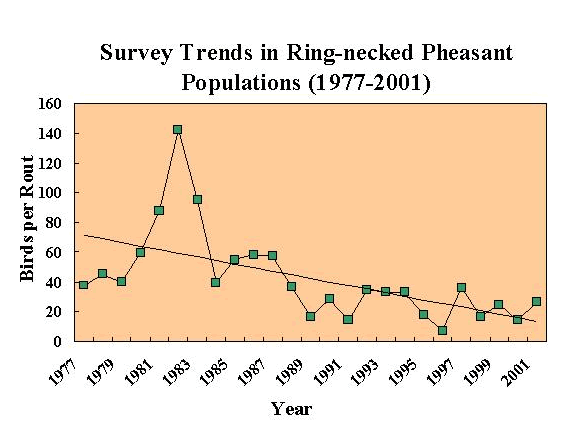
From the link below, it appears that aggressive stocking of pheasants began in about 1964.
http://www.tpwd.state.tx.us/landwater/land/habitats/high_plains/upland_game/pheasant.phtml
[This message has been edited by CanyonAg77 (edited 11/18/2008 12:32p).]
From the link below, it appears that aggressive stocking of pheasants began in about 1964.
http://www.tpwd.state.tx.us/landwater/land/habitats/high_plains/upland_game/pheasant.phtml
quote:
According to Texas Parks and Wildlife (TPW) records, the first pheasants in the High Plains and Northern Rolling Plains of Texas immigrated from western Oklahoma in 1939 or 1940. Private releases of birds during the 1930s and 1940s by private landowners in the Panhandle of Texas also helped to establish populations of Ring-necked Pheasants in several areas of the region. In 1946, Paul V. Jones of the Texas Game, Fish and Oyster Commission described the pheasant population in the Panhandle as being "extremely spotty in distribution and consisting of a drifting and very intermittent population." He estimated the maximum population size at 1000 birds and remarked "the true figure is in all probability considerably less than that."
In 1950, Ring-necked Pheasants occupied portions of at least 18 counties, occurring primarily along tributaries, rivers, and other riparian habitat corridors of the Texas Panhandle. The face of agriculture changed drastically during the 1950s as ranching on shortgrass prairie and dry land farming were replaced by irrigated cropland throughout much of the High Plains and Northern Rolling Plains. Unlike many of the other upland game birds that need and prefer rangeland, pheasants are dependent on landscapes dominated by cultivation. Pheasant populations grew with the increase in cultivation, furrow irrigation, and moderate farming intensity.
Occurrence of ring-necked pheasants in the region, coupled with recognition that land use changes altered, if not diminished habitat of many native game species, led TPW to initiate a program to release propagated pheasants in unoccupied areas of the Texas Panhandle. During this era, TPW, private individuals, sportsman, and civic groups were releasing birds concurrently. Areas stocked by TPW met minimum criteria of: (1) having at least 10,000 acres with large areas of grain farming; and (2) interspersed with pastures, hay fields and odd areas. Release of both captive raised and wild caught pheasants of several varieties or hybrids were made from 1964 to 1974 in Lubbock, Bailey, Hale, Carson, and Gray counties.
[This message has been edited by CanyonAg77 (edited 11/18/2008 12:32p).]
Interesting graph. I think my first pheasant hunt to tag along was 83 and I was 14. I remember tons and tons of pheasants in this overgrown weed patch. there were birds everywhere. I thought man this is cool.
does texas parks and wildlife still run this sort of data? and if so where can you get the up to date numbers that they are counting?
Just got back from pheasant hunt around Spearman and Dumas. There were lots of birds, especially around Dumas.
guided groups for 3 days straight. Limited everyday near Spearman.
Awesome news guys. We'll be up at stratford starting on friday. Here's to hoping you didn't shoot em all. I'll let you know how it turns out.
Featured Stories
See All
71:10
7h ago
4.1k
Lunch with Looch: Texas A&M football's leadership group
by Billy Liucci
37:02
11h ago
3.1k
A 'Smart' list: Power ranking SEC coaches
by Connor O'Gara
12:45
12h ago
1.8k
20:05
13h ago
2.9k
Aggie95
Best things to come out the World Cup...and potential impacts on CFB and NFL.
in Billy Liucci's TexAgs Premium
49