247 years

1,862 Views | 13 Replies | Last: 3 yr ago by cavscout96
cavscout96
How long do you want to ignore this user?
AG
Minutemen skirmish with Pitcairn on Lexington Green and subsequent battle at Concord Bridge 247 years ago today.

Found last year records that my wife's family had land dealings with Samuel Whittemote in the period just before the start of the Revolution.

If you don't know his story, click the link. Fascinating.

ABATTBQ87
How long do you want to ignore this user?
AG
"The ultimate authority … resides in the people alone. … The advantage of being armed, which the Americans possess over the people of almost every other nation … forms a barrier against the enterprises of ambition, more insurmountable than any…" James Madison (Federalist No. 46)

Near midnight on April 18th, 41-year-old Paul Revere, who had arranged for warnings of British movements, departed Charlestown (near Boston) for Lexington and Concord to warn John Hancock, Samuel Adams, and other Sons of Liberty that the British Army was marching to arrest them and seize their weapons caches. After meeting with Hancock and Adams in Lexington, Revere was captured, but his Patriot ally, Samuel Prescott, continued to Concord and warned militiamen along the way.

The Patriots in Lexington and Concord, with other citizen militias in New England, were bound by "minute man" oaths to "stand at a minute's warning with arms and ammunition." The oath of the Lexington militia read thus: "We trust in God that, should the state of our affairs require it, we shall be ready to sacrifice our estates and everything dear in life, yea, and life itself, in support of the common cause."

In the early dawn of April 19, their oaths would be tested with blood. Under the command of 46-year-old farmer and militia Captain John Parker, 77 militiamen assembled on the town green at Lexington, where they soon faced Smith's overwhelming force of seasoned British regulars. Parker did not expect shots to be exchanged, but his orders were: "Stand your ground. Don't fire unless fired upon, but if they mean to have a war, let it begin here."

Within close musket range from the Patriots' column, British Major John Pitcairn swung his sword and ordered, "Lay down your arms, you damned rebels!"

Not willing to sacrifice his small band of Patriots on the green, as Parker later wrote in a sworn deposition, "I immediately ordered our Militia to disperse, and not to fire." But his Patriots did not lay down their arms. Then under Pitcairn's orders, as Parker testified, "Immediately said Troops made their appearance and rushed furiously, fired upon, and killed eight of our Party without receiving any Provocation therefor from us." Ten other Patriots were wounded.

As the American militia retreated toward Concord with the British in pursuit, their ranks grew to more than 400

In Concord, the British divided to search for armament stores. Before noon, the second confrontation between regulars and militiamen occurred as 100 British light infantry from three companies faced the ranks of militia and minutemen at Concord's Old North Bridge. From depositions on both sides, the British fired first, killing two and wounding four.

This time, however, the militia commander, Major John Buttrick, ordered, "Fire, for God's sake, fellow soldiers, fire!"

And fire they did. The volley commenced with what poet Ralph Waldo Emerson later immortalized as "The Shot Heard Round the World." With that shot, farmers, laborers, landowners, and statesmen alike brought upon themselves the sentence of death for treason. In the ensuing firefight, the British suffered heavy casualties. In discord, the Redcoats retreated to Concord proper and, after reinforcing their ranks, marched back toward Lexington.

During their Concord retreat, British regulars took additional casualties in sporadic firefights. The most notable of those was an ambush by the reassembled ranks of John Parker's militia, which became known as Parker's Revenge. Despite reinforcements when they returned to Lexington, the King's men were no match for the Patriot ranks. The militia and minutemen inflicted heavy casualties upon the Redcoats along with their 18-mile tactical retreat to Boston.

By day's end, the Patriots suffered 49 killed, 39 wounded, and five missing. The British casualties totaled 73 killed, 174 wounded, and 26 missing.

Upon hearing of those first shots fired in what would become an eight-year struggle for American Liberty, Samuel Adams declared to fellow Patriot John Hancock, "What a glorious morning this is!"

Indeed it was and remains with every sunrise over our nation since.

Thus began the American Revolution a revolution not just for the people of Massachusetts but for the cause of Liberty for all mankind, such rights not being temporal but eternal.

pmart
How long do you want to ignore this user?
ABATTBQ87 said:

Thus began the American Revolution a revolution not just for the people of Massachusetts but for the cause of Liberty for all mankind, such rights not being temporal but eternal.


ABATTBQ87
How long do you want to ignore this user?
AG
pmart said:

ABATTBQ87 said:

Thus began the American Revolution a revolution not just for the people of Massachusetts but for the cause of Liberty for all mankind, such rights not being temporal but eternal.


I didn't write that paragraph, just copied and pasted
cbr
How long do you want to ignore this user?
AG
pmart said:

ABATTBQ87 said:

Thus began the American Revolution a revolution not just for the people of Massachusetts but for the cause of Liberty for all mankind, such rights not being temporal but eternal.


Lol, read some actual history. Not howard zinn's bull*****

America launched as the least corrupt, most tolerant, most inclusive, most meritocratic major culture and government in human history.

Yes, there were wrongs and inequities, just like every other culture in history. Just fewer of them.
pmart
How long do you want to ignore this user?
Sorry, I was a bit lazy in my post. My point is that you can celebrate the greatness of our country without hyperbole and untrue statements that ignore the history of large segments of our population. In a couple of weeks we will see Putin celebrate the greatness of the Soviet victory over nazi germany, but I imagine many of us will say, "yeah great, but what about all the atrocities Stalin and the soviets committed".

Edited to add Stalin (yuck)
cbr
How long do you want to ignore this user?
AG
pmart said:

Sorry, I was a bit lazy in my post. My point is that you can celebrate the greatness of our country without hyperbole and untrue statements that ignore the history of large segments of our population. In a couple of weeks we will see Putin celebrate the greatness of the Soviet victory over nazi germany, but I imagine many of us will say, "yeah great, but what about all the atrocities he and the soviets committed".


Fair point. I guess its a matter of perspective. Our country started with slavery and an overall pattern of destruction of native culture… which essentially every other culture in history did also. Did the revolution itself help indians and slaves right away? Id say no. Did this country rapidly include these groups in every way over the few generations? Absolutely. More so than any other major culture in history? I'd say yes.

CanyonAg77
How long do you want to ignore this user?
AG
pmart said:

Sorry, I was a bit lazy in my post. My point is that you can celebrate the greatness of our country without hyperbole and untrue statements that ignore the history of large segments of our population.


Italian-Americans?
Sapper Redux
How long do you want to ignore this user?
Quote:

America launched as the least corrupt, most tolerant, most inclusive, most meritocratic major culture and government in human history.


I'm sorry, but no it didn't.

There was nothing particularly meritocratic about American society during and immediately after the Revolution. With a handful of exceptions, mostly in the North, power rested in the hands of the landed gentry and was passed down generationally. This is without getting into the issues of slavery and native dispossession. Corruption was also endemic in the new nation. Scams abounded at the highest levels and typically targeted land ownership.
Sapper Redux
How long do you want to ignore this user?
Quote:

Did this country rapidly include these groups in every way over the few generations? Absolutely


Again, this is not accurate.
pmart
How long do you want to ignore this user?
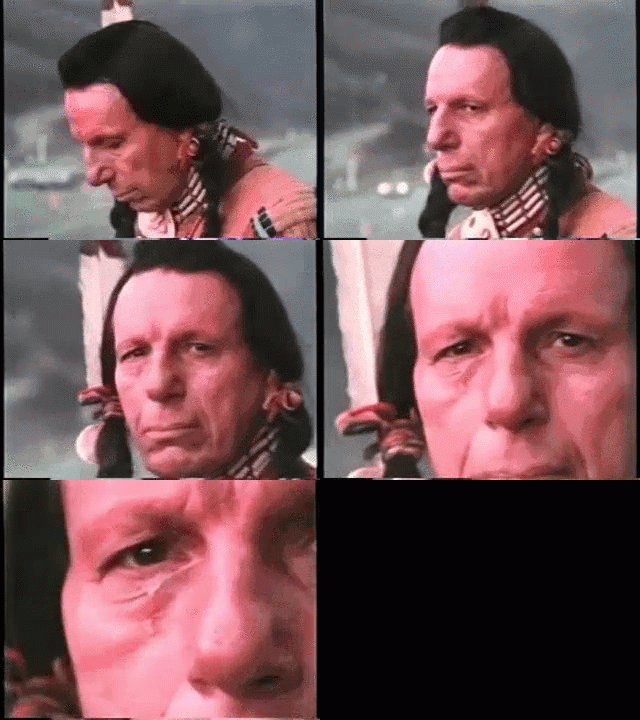
Yeah, Iron Eyes Cody could probably have his own thread!
cbr
How long do you want to ignore this user?
AG
Sapper Redux said:

Quote:

America launched as the least corrupt, most tolerant, most inclusive, most meritocratic major culture and government in human history.


I'm sorry, but no it didn't.

There was nothing particularly meritocratic about American society during and immediately after the Revolution. With a handful of exceptions, mostly in the North, power rested in the hands of the landed gentry and was passed down generationally. This is without getting into the issues of slavery and native dispossession. Corruption was also endemic in the new nation. Scams abounded at the highest levels and typically targeted land ownership.
humanity can't exist without corruption and scams wherever you have entrenched power.

western european ethics kept it down better than most other cultures, but when other people's money is in play, it is impossible for it not to become corrupt.

that is WHY this country was created - to put SEVERE limitations on 'other people's money' and government power.

and it worked.

government power was extremely limited. for a while, it was run by extremely ethical men, perhaps uniquely so in the history of mankind.

over time, these people expanded the inclusivity of all americans.

americans of any race or ethnic background could go out and own land, work it, profit from it, and be equal, if they went far enough west or to the right territories. obviously, some areas had entrenched landowning slave owners and they created their own brand of bad news, but it wasnt coming from the masses, nor was it coming from the government.

people that live amongst each other, provide services to each other, and respect each other are the bastion of ethics and the american dream.

wherever you have big power and other peoples money - governments, organized religions, unions, etc., only the most corrupt people can ever rise to the top of such organizations. that is why the world sucks. that is why america WAS great.

that was as good as it gets.

in the modern world, those traditionally suppressed groups became exploitable useful idiots by a massive, corrupt government. its now just orwellian dystopia, and the only reason you still feel kind of free is because it's easier for them to let you pay your mortgage and car note as long as you play into the system quietly.


Sapper Redux
How long do you want to ignore this user?
Quote:

government power was extremely limited. for a while, it was run by extremely ethical men, perhaps uniquely so in the history of mankind.


This is bizarrely idealized. Should we get into the wide variety of ways the framers were not ethical?
cavscout96
How long do you want to ignore this user?
AG
Sapper Redux said:

Quote:

government power was extremely limited. for a while, it was run by extremely ethical men, perhaps uniquely so in the history of mankind.


This is bizarrely idealized. Should we get into the wide variety of ways the framers were not ethical?
alternately, you could enlighten us with a better example in history.....
Refresh
Page 1 of 1
 
×
subscribe Verify your student status
See Subscription Benefits
Trial only available to users who have never subscribed or participated in a previous trial.