
https://www.smithsonianmag.com/air-space-magazine/first-space-ace-180968349/
Obvious relevancy to history and TAMU - especially noting his callsign.
Edit: formatting and adding picture.
https://th-thumbnailer.cdn-si-edu.com/v0u0-DXGOMH_zEzOSsxHWeAUWZ0=/fit-in/1072x0/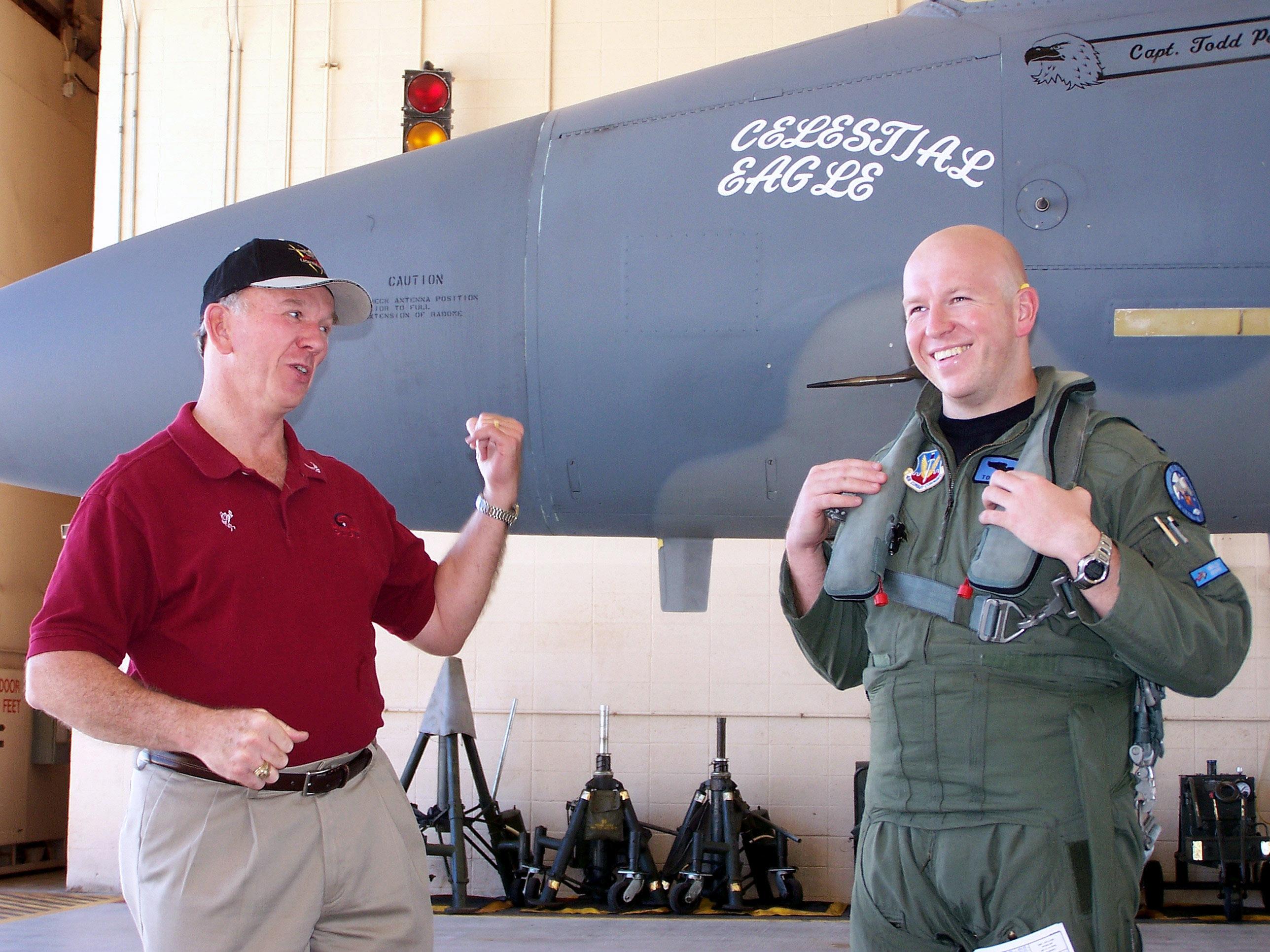
The same F-15A he used was later piloted by his son. And if you zoom in on Doug's right hand, it's clearly an Aggie ring.
Obvious relevancy to history and TAMU - especially noting his callsign.
Quote:
On September 13, 1985, at 12:42 p.m., Major Wilbert "Doug" Pearson pushed the "pickle button" in the cockpit of his F-15A, launching a missile high over the Pacific Ocean. He was in a steep vertical climb, flying at just under Mach 1, and was at 36,000 feet. The missile roared toward its target, the Solwind P78-1 satellite moving at 17,500 mph, almost 300 miles above Pearson's aircraft. As the missile disappeared from view, all Pearson could do was wait - he wouldn't be able to see if it had hit the target. But his friend Scott in the control room would know. They worked out a code so Pearson could find out when he radioed Scott after the launch.
Recalls Pearson: "I'd tell him 'I'm going to level off at 36,000 feet.' And if we've had a successful intercept, you'll say, 'Roger, Aggie-1 [Pearson's call sign]. That's a good altitude.' And if we missed, you'll say, 'Roger, Aggie-1. Recommend you go to 28,000 feet' or some different number. Well, Scott never had to say a word," Pearson laughs. "He just keyed the microphone and I heard all the screaming and hollering and yelling and cheering in the background."
Edit: formatting and adding picture.
https://th-thumbnailer.cdn-si-edu.com/v0u0-DXGOMH_zEzOSsxHWeAUWZ0=/fit-in/1072x0/
The same F-15A he used was later piloted by his son. And if you zoom in on Doug's right hand, it's clearly an Aggie ring.