Main Breaker Amperage

4,303 Views | 47 Replies | Last: 3 yr ago by aggiecody06
dubi
How long do you want to ignore this user?
AG
JP76 said:

I have also seen 100 amp panel run no problem on numerous houses from the 50's to 60's with even an electric range and electric dryer and electric water heater. The problem is if it does not have gas heat then usually the panel has to be upgraded.


We lived there with our gas dryer without issue. When we moved and bought an electric dryer for our tenants all heck broke loose.
JP76
How long do you want to ignore this user?
It was tripping main with all gas appliances and a electric dryer ?
Gas water heater too ?


What brand is the breaker box ? Square D ?


Most electric dryers pull around 20 amps

I have actually seen 100 amp main run range, water heater, electric central heat and electric dryer on numerous duplexes with never an issue. Also most older manufactured homes came with 100 amp and were all electric.

dubi
How long do you want to ignore this user?
AG
JP76 said:

It was tripping main with all gas appliances and a electric dryer ?
Gas water heater too ?


What brand is the breaker box ? Square D ?


Most electric dryers pull around 20 amps

I have actually seen 100 amp main run range, water heater, electric central heat and electric dryer on numerous duplexes with never an issue. Also most older manufactured homes came with 100 amp and were all electric.


I had the breaker box replaced the following year because I had a family who wanted a 3 year lease so I'm unsure of the brand. I suspect it was one of those awful ones that warned it should be replaced.
Gas water heater
Gas furnace
Electric range
Electric dryer

The home we live in now is all gas appliances and zero issues on a 100amp panel.
74AnimalA
How long do you want to ignore this user?
AG
aggiecody06 said:

4/3 2700 sq ft, one and half story with 3 car garage, main panel on outside of house
Even in New Builds, Many GAS Houses (Heat, Hot H2O, Range, Gas Dryer, etc) I have seen only a 150a Main Breaker. Believe in these houses, the only 220v is for the A/C.

All Elect Houses seem to have a 200 (Elect Heat, Range, Oven, Dryer, etc.) There will be many more 220 Breakers.

And it varies from local to local. There may be an Local Elect Code or Practice to install the Main Breaker based upon the Design Load. (Note NOT a EE or Licensed Sparky). Or it's the builder that can save $20 a house by accepting the smaller breaker. ????

Oh and that 208v nomenclature. I have only actually seen that in Industrial applications which often use 3-phase power.

Now, why are your appliances, lamps etc listed as 110v, but your outlets say 115v? Keeping it simple. Then what is the difference between 220 & 240. Well, 220 comes from adding both 100 legs together. Then how did they get the 240? Even 115v x 2 Equals ???? (Hint it's not 240)
BenTheGoodAg
How long do you want to ignore this user?
AG
I guess congratulations are in order to the OP's electrician for his successful smoke-screen, haha.

That said, it's an interesting topic and here are a few answers.

74AnimalA said:

aggiecody06 said:

4/3 2700 sq ft, one and half story with 3 car garage, main panel on outside of house
Even in New Builds, Many GAS Houses (Heat, Hot H2O, Range, Gas Dryer, etc) I have seen only a 150a Main Breaker. Believe in these houses, the only 220v is for the A/C.

All Elect Houses seem to have a 200 (Elect Heat, Range, Oven, Dryer, etc.) There will be many more 220 Breakers.

And it varies from local to local. There may be an Local Elect Code or Practice to install the Main Breaker based upon the Design Load. (Note NOT a EE or Licensed Sparky). Or it's the builder that can save $20 a house by accepting the smaller breaker. ????
In short, nearly every local code is going to follow the NEC for minimum sizing. Combine that with current supply chain issues, bulk purchasing power (buying 200A panels in bulk), cheap/good builders, you'll see a range of solutions here. I'm not a residential guy, but I think it's typical for 200A panels to come loaded with more space as well, so that factors into it.

ETA - I'd also speculate that some designers have taken advantage of the widespread adoption of LEDs and some other high efficiency appliances in new builds. Especially for lighting, the reduction in load is not insignificant.

74AnimalA said:

Oh and that 208v nomenclature. I have only actually seen that in Industrial applications which often use 3-phase power.
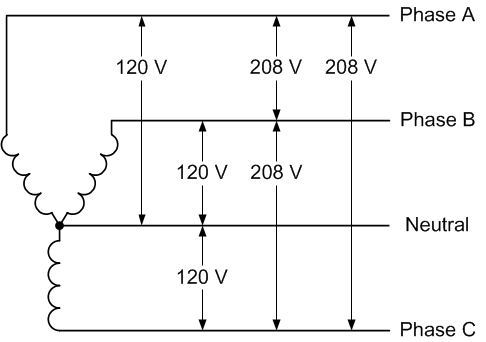
This is effectively true, but based on the circumstances. Many devices are listed for a range that allows them to be used on either a 208V or 240V supply. It has more to do with the practicality of how industrial facilities and residential neighborhoods are configured than a hard and fast rule

In a 3-phase system, the sine waves are offset by 120 degrees, so mathematically, the phase-to-phase voltage is 208V. Short distances and a high number of 208V-240V loads in industrial facilities makes this practical. It's not cost-effective running neutrals everywhere.


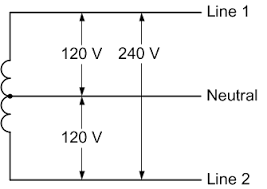
In a residential neighborhood, it's cheaper to keep everything single phase - It's not cost effective running phase conductors everywhere. Someone very clever figured out how to get two separate voltages by tapping and neutral/grounding the center of the load side of a transformer winding, so the phase to phase voltage is 240V, but the voltage between the phase and the tap is 120V. The sine waves are 180 degrees offset. It's an elegant solution.


74AnimalA said:

Now, why are your appliances, lamps etc listed as 110v, but your outlets say 115v? Keeping it simple. Then what is the difference between 220 & 240. Well, 220 comes from adding both 100 legs together. Then how did they get the 240? Even 115v x 2 Equals ???? (Hint it's not 240)
Between voltage drop and floating supply, it's pretty typical for system voltage to be listed at the nominal value (120V) and loads to be listed at the low range they will work properly (110V), but they're all the same: 110V (load) = 115V = 120V (supply). Same for 240V systems. And 480V. And 6.9kV. Etc. For example, a 6.9kV (system voltage) motor is typically listed as a 6600V motor (load).

As alluded to in the above diagram, 120V (system voltage) x 2 legs definitely equals 240V (System voltage)
UnderoosAg
How long do you want to ignore this user?
AG
^^ that. There's no such animal as 220. The nominal voltage is 240 regardless of what some call it. Ditto for 120.

The minimum design load for lighting is based on square footage at 3 va per. There's not a way to use efficiencies to alter it. The 2020 NEC is the first in forever to have the lighting table reduced for commercial applications to better align with things like ASHRAE 90.1, but it's only for non-dwellling units.
UnderoosAg
How long do you want to ignore this user?
AG
You can also put a 125, 150, 175, or 200 main into a 200A panel. Buy the 200A can and then size the breaker and wire to the calculated load, and always have a can on hand to rough in.
BenTheGoodAg
How long do you want to ignore this user?
AG
Interesting. Thanks!
Whoop Delecto
How long do you want to ignore this user?
AG
aggiecody06
How long do you want to ignore this user?
Alset (Tesla spelled backwards), is energy efficient homes that are being built. Supposedly come with solar panels and a Tesla, don't ask me how that works because nothing is being said about it. Check out website here….


https://www.alsetehome.com/
aggiecody06
How long do you want to ignore this user?
Also as follow up the issue has been resolved, had them change element on water heater and still was tripping. Finally had entire water heater replaced and all is good now. It was under warranty so no skin off my back luckily. Thanks for all help and info!
UnderoosAg
How long do you want to ignore this user?
AG
Glad you got it worked out. I'd want to call that electrician again, but then sometimes I'm an ******* like that.

The thing to remember with energy efficient homes (at least when done sincerely) is that it's not just light bulbs. You add more and better insulation and low E windows and you can reduce HVAC load. Then you add premium efficiency HVAC equipment and the electrical load goes down. Voila, the house has a 125A service, and also why it's hard to compare older houses to new.
aggiecody06
How long do you want to ignore this user?
Our house isn't part of the e-home community aspect. We were in phase 1 with regular volume builder. The future phases were sold to the ehome community aspect incorporated. They haven't built one yet but looking forward to see how they turn out.
Refresh
Page 2 of 2
 
×
subscribe Verify your student status
See Subscription Benefits
Trial only available to users who have never subscribed or participated in a previous trial.
