Natural Growth Decay Due to Social Circles

2,952 Views | 18 Replies | Last: 6 yr ago by expresswrittenconsent
NASAg03
How long do you want to ignore this user?
Interesting statements from a Nobel prize winner for when and why the growth rate will naturally decay based on social interactions and limited case studies prior to significant measures taking place.

"When Levitt started analyzing the data on February 1, Hubei had 1,800 new cases each day and within six days this number reached 4,700, he said. "And then, on February 7, the number of new infections started to drop linearly and did not stop. A week later, the same happened with the number of the deaths. This dramatic change in the curve marked the median point and enabled better prediction of when the pandemic will end. Based on that, I concluded that the situation in all of China will improve within two weeks. And, indeed, now there are very few new infection cases."

"There are several reasons for this, according to Levitt. "In exponential growth models, you assume that new people can be infected every day, because you keep meeting new people. But, if you consider your own social circle, you basically meet the same people every day. You can meet new people on public transportation, for example; but even on the bus, after some time most passengers will either be infected or immune."

Another reason the infection rate has slowed has to do with the physical distance guidelines. "You don't hug every person you meet on the street now, and you'll avoid meeting face to face with someone that has a cold, like we did," Levitt said. "The more you adhere, the more you can keep infection in check. So, under these circumstances, a carrier will only infect 1.5 people every three days and the rate will keep going down."


https://www.calcalistech.com/ctech/articles/0,7340,L-3800632,00.html

Michael Levitt, Stanford professor and Nobel prize winner for "the development of multiscale models for complex chemical systems."

tldr: interacting with the same people in our lives regularly, and natural social distancing for people we don't know, ensure that a 2.2 growth rate isn't sustainable.
Mike Shaw - Class of '03
Post removed:
by user
HotardAg07
How long do you want to ignore this user?
AG
This explains the math very well:


Today's graph, which carries on what the video showed ending at March 6th.
NASAg03
How long do you want to ignore this user?
Really good video thanks for posting this.

"Max number of cases is 2X the inflection point (when growth become linear)."

The question is, when is the inflection point? Is it proportional to population size?
Mike Shaw - Class of '03
74Ag1
How long do you want to ignore this user?
AG
Good video Hotard
eidetic78
How long do you want to ignore this user?
AG
NASAg03 said:

Really good video thanks for posting this.

"Max number of cases is 2X the inflection point (when growth become linear)."

The question is, when is the inflection point? Is it proportional to population size?
What the case load is when the inflection point is eventually reached depends on a whole lot of things, including population size, but also human behavior and the pathogen itself. As I'm sure you understand, the main point in limiting interactions to our immediate social circles is to hit that point as soon as possible.

It's hard to tell right now because of the lag time from administering a test to getting the results (currently 4/5/6 days), so today's "new confirmed" cases are actually last week's tests.
plain_o_llama
How long do you want to ignore this user?
You can also see why some argue we aren't being serious about it as long as such things as Spring Break travel are shuffling the exposed amongst the unexposed.

There is an interesting tension as to ease of spread in a place like NYC. Limiting social circles implies not being exposed to random people outside your social circle. Yet travel by subway is potentially a very good way to insure that you interact with random people.

NASAg03
How long do you want to ignore this user?
That is unless extreme measures artificially create an inflection point, measures are reduced, things go back to normal, and cases explode again (which is the concern in Asia).

Again that's one of the arguments against the shelter in place and major social disruptions. If the natural inflection point is much lower than expected due to natural societal social distancing and circles, and the asymptomatic carrier % is much higher than expected, then long-term disruption to the economy might not be justified, and might result in more harm than good.
Mike Shaw - Class of '03
HotardAg07
How long do you want to ignore this user?
AG
I would think that is a very likely outcome, considering nobody has immunity and we have no vaccine or widespread treatment. Even the supression of the virus during the summer wouldn't kill it, only stall it long enough to return next fall. To that end, our efforts could be best described as buying time until a vaccine or treatment could be mass produced.
eidetic78
How long do you want to ignore this user?
AG
plain_o_llama said:

You can also see why some argue we aren't being serious about it as long as such things as Spring Break travel are shuffling the exposed amongst the unexposed.

There is an interesting tension as to ease of spread in a place like NYC. Limiting social circles implies not being exposed to random people outside your social circle. Yet travel by subway is potentially a very good way to insure that you interact with random people.


Definitely, public transit is a potential problem, and could be a reason for additional spread in areas that heavily rely on it. Pure speculation on my part though, but makes logical sense.

I believe, and am hopeful, that enough people are limiting their travel to drop the transmission rate significantly. But because of the relatively long incubation period combined with the long testing result turn-around, the effect won't be evident for some time (couple of weeks at least), and we'll see how people hold up along the way.

My personal feeling is that this will take a much longer period of behavior modification to stop another big spike.

100% compliance is never an option when humans are involved.

There's a significant part of the population that views any external compulsion as a challenge to their independence and freedom, and will abandon rational thought to fend off the perceived oppression.
Comanche_Ag
How long do you want to ignore this user?
AG
NASAg03 said:

That is unless extreme measures artificially create an inflection point, measures are reduced, things go back to normal, and cases explode again (which is the concern in Asia).


That's my concern.
NASAg03
How long do you want to ignore this user?
Longterm quarantine of a healthy public isn't feasible. At some point major supply chains break down, riots occur, and the virus ends up spreading naturally anyway.

At that point the economy is wrecked, there's rioting, the public has lost all faith in the government, and you're in a way worse condition than before.

Max this draws out is 15 days. That's the promise. That's the limit.

If the public doesn't see significant results, all hell will break loose, with or without government mandates.
Mike Shaw - Class of '03
Zobel
How long do you want to ignore this user?
AG
You don't think it had anything to do with the draconian quarantine measures China implemented?
94chem
How long do you want to ignore this user?
The inflection point likely can't occur before the system reaches equilibrium. In this case, modeling the problem as diffusion, that would mean globally similar infection rates, probably adjusted for very complex things such as social norms, population density, testing accuracy, etc. If you were to take a sparsely populated region with high compliance against a densely populated region with poor compliance, both at peak, you would likely be near equilibrium when every other region's per capita infection rate fell between those two. Then hopefully the die out theory, i.e. inflection point, would occur.

India and Nigeria are 2 places I would watch. On the low end, Russia should be able to stifle it pretty well.
Zobel
How long do you want to ignore this user?
AG
For general info. Apologies if you have seen this as I have posted it elsewhere.

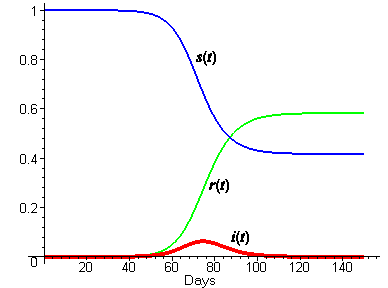
A very simple model for epidemic progression assumes everyone is in one of three buckets - SIR - susceptible-infected-removed. At the beginning everyone is susceptible, then over time people become infected, then removed (recovered or dead).

You get a curve for each over time that looks something like this.


The cumulative total follows C(t) = C0*e^rt where C0 is the initial number of people who have it and r is a function of R0 and the mean infectious period - how long each person can make someone else sick.

R0 itself is the product of the rate of production of new exposures times new infections, which works out as the number of infections generated by generation zero in a naive population. Think of it as, each person infects x people.

This shows us that the cumulative number of infections depends on the disease itself - the infectious period plus how transmissible it is - combined with our behavior, which factors into R0. If R0 = 1 growth stalls.

The formula for the number of susceptible people (s) at the end of the pandemic is log (s) = R0 *(s- 1). If you solve that and plot out the % susceptible at the end vs R0 you get this.


What he's talking about is spontaneous social dynamics changing R0. I don't think the social dynamics are sufficient, though. A recent publication in Nature had this in the introduction:
Quote:

For a completely novel pathogen, especially one with a high [R0 say >2]...assuming homogeneous mixing and mass action dynamics, the majority of the population will be infected eventually unless drastic public health interventions are applied over prolonged periods and/or vaccines become available sufficiently quickly.

Even under more realistic assumptions about mixing informed by observed clustering of infections within households and the increasingly apparent role of superspreading events...at least one-quarter to one-half of the population will very likely become infected, absent drastic control measures or a vaccine.

(Also: he made a comment about the Diamond Princess. Yes, ultimately the %infected was around 19%. But they stopped the experiment. If they had continued to lock them in there, it would have almost certainly been much, much higher).

Disclaimer: Am not expert. Am not epidemiologist. Above may have errors or may just be wrong-headed.
NASAg03
How long do you want to ignore this user?
I think your plots do a great job of showing that there's many more variables involved than simply x^y.

x is a function of initial infections, immunity, and number of new infection points, all which can vary with time.

y is a function of social circles, community size, job types, social norms, virus behavior, all of which are a also a function of time.

You barely tweak just a few variables, and you get drasticly different outcomes. tweak them all to worst case possible, and you get panic that from what might be possible, but not realistic.
Mike Shaw - Class of '03
zebros_95
How long do you want to ignore this user?
AG
Well this is good news since we are at 90+ days since the virus arrived in the US.
Zobel
How long do you want to ignore this user?
AG
That plot there is just arbitrary, I stole it from the googles.
zebros_95
How long do you want to ignore this user?
AG
Yeah my sarcasm emoji was broken!
expresswrittenconsent
How long do you want to ignore this user?
plain_o_llama said:

You can also see why some argue we aren't being serious about it as long as such things as Spring Break travel are shuffling the exposed amongst the unexposed.

There is an interesting tension as to ease of spread in a place like NYC. Limiting social circles implies not being exposed to random people outside your social circle. Yet travel by subway is potentially a very good way to insure that you interact with random people.


If NYC residents are sheltering in place, subway use will be mostly limited to those who cannot WFH and tourists. Every place you can live in NYC has multiple supermarkets and banks and c-stores and barber shops and hospitals and 100 restaurants within a 3 block radius.
Refresh
Page 1 of 1
 
×
subscribe Verify your student status
See Subscription Benefits
Trial only available to users who have never subscribed or participated in a previous trial.