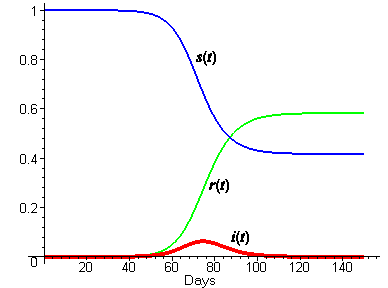
Interesting statements from a Nobel prize winner for when and why the growth rate will naturally decay based on social interactions and limited case studies prior to significant measures taking place.
"When Levitt started analyzing the data on February 1, Hubei had 1,800 new cases each day and within six days this number reached 4,700, he said. "And then, on February 7, the number of new infections started to drop linearly and did not stop. A week later, the same happened with the number of the deaths. This dramatic change in the curve marked the median point and enabled better prediction of when the pandemic will end. Based on that, I concluded that the situation in all of China will improve within two weeks. And, indeed, now there are very few new infection cases."
"There are several reasons for this, according to Levitt. "In exponential growth models, you assume that new people can be infected every day, because you keep meeting new people. But, if you consider your own social circle, you basically meet the same people every day. You can meet new people on public transportation, for example; but even on the bus, after some time most passengers will either be infected or immune."
Another reason the infection rate has slowed has to do with the physical distance guidelines. "You don't hug every person you meet on the street now, and you'll avoid meeting face to face with someone that has a cold, like we did," Levitt said. "The more you adhere, the more you can keep infection in check. So, under these circumstances, a carrier will only infect 1.5 people every three days and the rate will keep going down."
https://www.calcalistech.com/ctech/articles/0,7340,L-3800632,00.html
Michael Levitt, Stanford professor and Nobel prize winner for "the development of multiscale models for complex chemical systems."
tldr: interacting with the same people in our lives regularly, and natural social distancing for people we don't know, ensure that a 2.2 growth rate isn't sustainable.
"When Levitt started analyzing the data on February 1, Hubei had 1,800 new cases each day and within six days this number reached 4,700, he said. "And then, on February 7, the number of new infections started to drop linearly and did not stop. A week later, the same happened with the number of the deaths. This dramatic change in the curve marked the median point and enabled better prediction of when the pandemic will end. Based on that, I concluded that the situation in all of China will improve within two weeks. And, indeed, now there are very few new infection cases."
"There are several reasons for this, according to Levitt. "In exponential growth models, you assume that new people can be infected every day, because you keep meeting new people. But, if you consider your own social circle, you basically meet the same people every day. You can meet new people on public transportation, for example; but even on the bus, after some time most passengers will either be infected or immune."
Another reason the infection rate has slowed has to do with the physical distance guidelines. "You don't hug every person you meet on the street now, and you'll avoid meeting face to face with someone that has a cold, like we did," Levitt said. "The more you adhere, the more you can keep infection in check. So, under these circumstances, a carrier will only infect 1.5 people every three days and the rate will keep going down."
https://www.calcalistech.com/ctech/articles/0,7340,L-3800632,00.html
Michael Levitt, Stanford professor and Nobel prize winner for "the development of multiscale models for complex chemical systems."
tldr: interacting with the same people in our lives regularly, and natural social distancing for people we don't know, ensure that a 2.2 growth rate isn't sustainable.
Mike Shaw - Class of '03