
Study estimates epidemic is not under control in much of the US

8,475 Views | 66 Replies | Last: 5 yr ago by DadHammer
Fitch
How long do you want to ignore this user?
AG
I read that too a little ways back and couldn't quite make sense what was the issue. Seems like if there had been fraud that could have been sorted out pretty quick, but the articles didn't read that way.

At the time I chalked it up to Monte Carlo random number simulations and moved on. In my view the study was basically bunk when it landed given it outlined a "worst case, do nothing" scenario. Even if the gov't had done nothing, there are still a few brains out in the general population of America....people would have responded. That all said, the math works out in principle.
CompEvoBio94
How long do you want to ignore this user?
The purpose of a worst-case-what-if-everyone-ignores-this-disease model is not to predict what will happen, but to answer the question "is this disease serious enough to merit significant attention and attempts to fight it?" When the folks from Imperial College published their initial run with >2 million deaths in the US, the model was fulfilling its task. The answer was a resounding "yes this is very serious. Something will need to be done".

And, they were right. We've had to take measures to avoid the worst case.

Most academic code is ugly, and it wouldn't be surprising if there were some minor errors in it.

But the basic result is quite reasonable from their input parameter estimates (which were based on what we knew in early March). If R0 is around 3 then, over 2/3 of the population would be expected to get it if there is no vaccine or attempt to slow the spread. So that would be >200 million cases in the US. If IFR is around 1%, the >200 million cases in the US would imply >2 million deaths in the US.

The critique that the model must be bunk because it predicted > 2 million deaths is not germane, because that was not what that model was for. We've never had a disease that killed millions with at least some attempts to fight it. So, I really don't think anyone thought that we were going to do nothing. But we do ignore many diseases, so it is reasonable to use a model to ask "can we ignore this disease?"
GAC06
How long do you want to ignore this user?
AG
Guys, the model worked because it was wrong. Just think, if the IFR was 1% they would have been closer to right!

At least it started a conversation.
Pasquale Liucci
How long do you want to ignore this user?
AG
Yeah I'm trying to remember back to the "expose" on the model and some follow ups on that. What I got out of it was that a) the general press doesn't understand/doesn't care to understand convergence over a large n of random model runs and b) there were some concerns that the convergence number was not uniform. I could very well be wrong on b) but I am confident on a).

Regardless, I agree on the natural response independent of govt action. That's why the model always seemed so silly to me, without getting under the hood. They literally just took a hypothetical R value to calculate percent of population needed to reach immunity, multiplied by US population and theoretical IFR (that we are seeing was wayyy off) to get a number dead. Completely elementary back of the envelope math that didn't really include any assumptions about behavior. Any number of posters here could have done the same.
Fitch
How long do you want to ignore this user?
AG
Fair enough. If the intent was more in the vein of an "academic exercise" to model the total downside risk, then the report may have been fair, but we may agree was poorly messaged.

To clarify my contention, in my view these early reports failed (or were undermined) by not including a range of potential outcomes. It's an interesting situation where introducing an observed result changes the underlying conditions and dynamics the model was premised on.
BiochemAg97
How long do you want to ignore this user?
AG
k2aggie07 said:

"Effective" doesn't mean zero transmission. Well, I mean clearly if you could do that an eradicate the virus completely that would be great, but I don't think that was ever actually the goal. My understanding that the intent was to chip away at the transmission rate to try to keep it manageable and to reduce overshoot. Whatever numbers or goals you want to assign to "manageable" and whatever cost that is per reduction in transmission rate is clearly an open question, but there's no reason to make this a binary point (lockdown vs no).

A big disservice is done to the discussion when we lump all social distancing measures together as "lockdowns."
I used lockdown intentional. The issue is we are currently being told by some that reopening is too risky because X. Not reopening (thus lockdown) is not a way to get to herd immunity. Do you disagree?

Also, if effective means R<1, it would burn itself out long before herd immunity. At least for this wave, leaving us susceptible to an asymptomatic individual entering the country and starting another outbreak.
Zobel
How long do you want to ignore this user?
AG
They used Verity's IFR of 0.66% weighted by age for a composite of around 0.9% in the U.K.

The R0 value ranged from 2.2 to 2.5 (off the top of my head).

Neither the IFR nor R0 were arbitrary or "wayyyyyy" off.

And that also wasn't how they achieved the spread anyway, since the model was quite a bit more complex than that. Zero hedge and twitter really did a number on the subject. It'd be funny if it wasn't so sad.
BiochemAg97
How long do you want to ignore this user?
AG
fig96 said:

BiochemAg97 said:

BowSowy said:

Is "reaching herd immunity" the next page in the playbook for the people who want to keep things locked down?
Well that kinda doesn't work.

If you keep locked down and lockdowns are effective, you never get to herd immunity.

If you can get to herd immunity while locked down, then the lock down isn't effective, so why do it. See NYC where there was significant transmission of people in lockdown. China reported similar.
Would you agree that this lacks context that's really important? I've heard the same thing mentioned, but we don't know anything about whether or not these people were washing their hands and taking care of other hygiene, had family members working outside the home in higher risk areas, etc.

Just seems like saying "they were in lockdown but got it anyway" leaves a lot open to interpretation.
Well, we do have context for the China numbers, for what they are worth. China forced people to stay home, delivering rations by national guard and it was mostly spread among people who were locked up together.

I think there are a lot of things that go on there. it is very difficult/impossible to maintain proper social distance, sanitation, and isolation of people that live in the same house. Plus long exposure times with others in the same house (or possibly even apartment complex) increases the likelihood of spread.

Also, there was an incident with SARS where 1 individual infected an entire floor of a hotel. That was in one night. COVID19 may or may not be as contagious as SARS but it isn't a stretch to believe that you can get spread between people in different apartments on the same floor or in the same building for weeks on end.
Zobel
How long do you want to ignore this user?
AG
No argument here. Lockdowns (like restriction of personal movement) also didn't seem to even have much effect on transmission rate anyway. I can see good sense in trying to reduce the transmission rate.. just balancing cost to benefit. But that is not a clear trade off and hasn't been.
cone
How long do you want to ignore this user?
AG
their hospitalization rate across the population was way off

that completely informed the stated primary objective from March - April, nationwide
Zobel
How long do you want to ignore this user?
AG
Yep, agreed. The hospitalization rate for younger age groups was an assumption in the absence of information, and they missed there.
Carolin_Gallego
How long do you want to ignore this user?
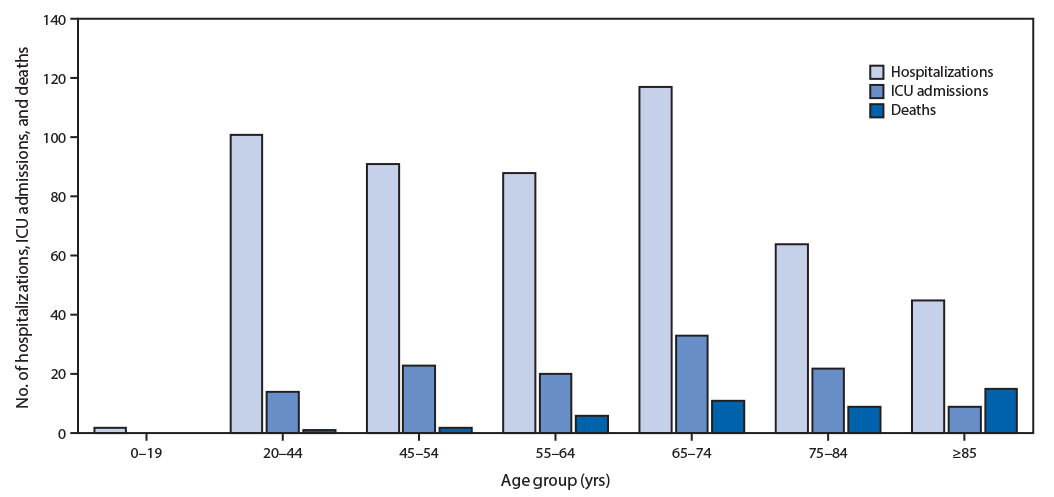
CDC - Coronavirus disease 2019 (COVID-19) hospitalizations,* intensive care unit (ICU) admissions, and deaths, by age group United States, February 12 - March 16, 2020
We believe progress is made through MORE discussion, not LESS, and we believe that to be true even if the topics are uncomfortable and we occasionally disagree with one another. - TexAgs
The name-calling technique making false associations is a child's game. The propagandist who uses this technique hopes that the audience will reject a person and their argument on this false basis.
BiochemAg97
How long do you want to ignore this user?
AG
Carolin_Gallego said:

CDC - Coronavirus disease 2019 (COVID-19) hospitalizations,* intensive care unit (ICU) admissions, and deaths, by age group United States, February 12 - March 16, 2020

The graph itself provides incomplete information without the context of the number of known cases for each age group. The table below the graph which shows percentages by age group would be more informative for policy decisions. Tiny percent of hospitalizations in the youth, growing to possibly as much as 70% for 85+. A possible 20% hospitalization for the bunk of the population (20-65) is still problematic.


This was the data at the time. We now know there is a high prevalence of asymptomatic cases.
tysker
How long do you want to ignore this user?
AG
Data from Feb 12 - March 16. Spring Break seems like forever ago.
Might as well use data from the the 1800s.
Carolin_Gallego
How long do you want to ignore this user?
tysker said:

Data from Feb 12 - March 16. Spring Break seems like forever ago.
Might as well use data from the the 1800s.
Did you already forget the topic? Not the OP's topic. It's a thread derail about study released by the same institution in mid March and how models can't be trusted (unless they support your preconceptions, of course).
We believe progress is made through MORE discussion, not LESS, and we believe that to be true even if the topics are uncomfortable and we occasionally disagree with one another. - TexAgs
The name-calling technique making false associations is a child's game. The propagandist who uses this technique hopes that the audience will reject a person and their argument on this false basis.
cone
How long do you want to ignore this user?
AG
but we now how serology results for major hard hit areas in Italy and the US and Spain and hospitalization numbers from across the country
americathegreat1492
How long do you want to ignore this user?
Something like 5 or 6 straight days with zero new cases, lowest total per capita in the country. It's good to be in the Big Sky.
beerad12man
How long do you want to ignore this user?
AG
To many in our population, it is no longer deemed worth it as a society. Whether some agree or not. It really is becoming as simple as that. 2.8-2.9 million American's will die this year. We aren't changing out entire culture/lifestyle to maybe, just maybe, prevent a few thousand deaths. And even then it's not really known if what we are doing is actually making a noticeable difference over the long haul, or possibly just delaying the inevitable.

The initial goal was to not overwhelm hospitals. While there will be some flare ups(see Marcus post), overall, we seem to be well equipped to handle them as a country moving forward.

COVID19 numbers cannot be the end all be all with all decision making moving forward. One country might have lower COVID deaths and therefore on paper, it looks like they are doing better. But is that what is really best for their country? I don't know. Would it be best for our country? In my opinion, no. As long as we stay under the medical curve, live your best life. That's my theory.
DadHammer
How long do you want to ignore this user?
AG
k2aggie07 said:

I read that inconsistency was from when they ported the code to a different language. The underlying model was published (and peer reviewed) in Nature in 2006. I'd be really, really surprised if it was horribly flawed / inconsistent.
Prepare to be surprised because it was trash.
DadHammer
How long do you want to ignore this user?
AG
Agree the main thing people don't seem to understand or refuse to understand is that,

Lockdowns are not proven to save any lives only kill people due to side consequences.

The virus is already here and Mostly targets a specific set of at risk people. Lots of just scared news media types on this board that want lock down forever for no proven reason what so ever. People under 50 are more at risk form the seasonal flue.

Amazing. We should have been 100% open weeks ago using common sense measures. Ridiculous.

California Ag 90
How long do you want to ignore this user?
AG
k2aggie07 said:

The hospitalization rate for younger age groups was an assumption in the absence of information, and they missed there.
good post.

this particular bit of speculation in that particular modeling exercise has had a pretty devastating impact on society.

it also will cause far greater skepticism of model-based forecasting for years to come.

We're from North California, and South Alabam
and little towns all around this land...
Zobel
How long do you want to ignore this user?
AG
That's just like your opinion man.
cone
How long do you want to ignore this user?
AG
the fact that no one has come out and said we were wrong, here's why, and how that should change our response moving forward

that miss was completely ignored, and that hurts public trust IMO
jeffdjohnson
How long do you want to ignore this user?
The messaging from leaders at all levels has been poor. The lack of context about this virus in the media has been poor as well. In both cases this is likely due to a lack of statistical understanding and an inability to think through the second order effects of the lockdown. #StayHomeSaveLIves was only partially true. I'm sure that it can be statistically proven that the spread of COVID-19 was slowed and that some number of people will live when they otherwise would have died. That is good. However, it has become virtuous (and easy) to advocate for this lockdown when the second order effects are not so simple.

This lockdown will cause an entirely different set of the population to die (maybe on a longer time scale) when they would have lived. Increases in suicides, domestic violence, missed cancer treatments, missed cancer screenings, missed vaccinations in children, fewer people getting treated for strokes, heart attacks and a long term potential economic depression (which will statistically decrease life expectancy), just to name a few.

No one wants to talk about it but our lockdown policy effectively picked winners and losers. It wasn't purely virtuous. Therefore, I think that is is only fair (and necessary) to talk about who we are "saving" in both cases. A lockdown will statistically save more older Americans considering that the median age of COVID-19 deaths in the United States is over 80 (with 43% of all COVID-19 deaths taking place in nursing homes). This is conjecture but I believe that the 2nd order effects of the lockdown will ultimately cause more total deaths than whatever lives we saved.
BiochemAg97
How long do you want to ignore this user?
AG
k2aggie07 said:

I read that inconsistency was from when they ported the code to a different language. The underlying model was published (and peer reviewed) in Nature in 2006. I'd be really, really surprised if it was horribly flawed / inconsistent.
The paper I read criticizing the code was that it was written in FORTRAN using programming techniques that were standard in the 70s. The article said running it on a different computer would produce different results. No discussion of porting it. And being written in FORTRAN it clearly wasn't ported from anything else before.

The thing about publishing a peer reviewed paper about a software program is that you don't have to actually provide the code to the reviewers. You might share the code after the fact to other researchers interested in your model, or maybe not.

I know several modeling programs in other fields that were published, were used by people who came out of the lab (former grad students/post docs) but wasn't particularly easy to use for anyone who wasn't taught the tricks. A lot of labs outside of comp Sci aren't very good at writing well documented, user friendly code.
Squadron7
How long do you want to ignore this user?
AG
BiochemAg97 said:

k2aggie07 said:

I read that inconsistency was from when they ported the code to a different language. The underlying model was published (and peer reviewed) in Nature in 2006. I'd be really, really surprised if it was horribly flawed / inconsistent.
The paper I read criticizing the code was that it was written in FORTRAN using programming techniques that were standard in the 70s. The article said running it on a different computer would produce different results. No discussion of porting it. And being written in FORTRAN it clearly wasn't ported from anything else before.

The thing about publishing a peer reviewed paper about a software program is that you don't have to actually provide the code to the reviewers. You might share the code after the fact to other researchers interested in your model, or maybe not.

I know several modeling programs in other fields that were published, were used by people who came out of the lab (former grad students/post docs) but wasn't particularly easy to use for anyone who wasn't taught the tricks. A lot of labs outside of comp Sci aren't very good at writing well documented, user friendly code.

It needs to be ported/upgraded to COBOL stat!
BiochemAg97
How long do you want to ignore this user?
AG
Fitch said:

I read that too a little ways back and couldn't quite make sense what was the issue. Seems like if there had been fraud that could have been sorted out pretty quick, but the articles didn't read that way.

At the time I chalked it up to Monte Carlo random number simulations and moved on. In my view the study was basically bunk when it landed given it outlined a "worst case, do nothing" scenario. Even if the gov't had done nothing, there are still a few brains out in the general population of America....people would have responded. That all said, the math works out in principle.
Yes, I believe the variability is due to something like a Monte Carlo simulation (although I don't have any actual knowledge of the code). However, the big complaint is that the results don't converge. A good Monte Carlo simulation would be run many times and the results would converge around some average value. That didn't seem to be happening. Maybe there were 2 or 3 clusters of values rather than a single cluster/average.

That said, worst case do nothing was simply for comparison to show that doing these other things would have been an improvement. But the media likes to focus on worst case scenarios.
BiochemAg97
How long do you want to ignore this user?
AG
jeffdjohnson said:

The messaging from leaders at all levels has been poor. The lack of context about this virus in the media has been poor as well. In both cases this is likely due to a lack of statistical understanding and an inability to think through the second order effects of the lockdown. #StayHomeSaveLIves was only partially true. I'm sure that it can be statistically proven that the spread of COVID-19 was slowed and that some number of people will live when they otherwise would have died. That is good. However, it has become virtuous (and easy) to advocate for this lockdown when the second order effects are not so simple.

This lockdown will cause an entirely different set of the population to die (maybe on a longer time scale) when they would have lived. Increases in suicides, domestic violence, missed cancer treatments, missed cancer screenings, missed vaccinations in children, fewer people getting treated for strokes, heart attacks and a long term potential economic depression (which will statistically decrease life expectancy), just to name a few.

No one wants to talk about it but our lockdown policy effectively picked winners and losers. It wasn't purely virtuous. Therefore, I think that is is only fair (and necessary) to talk about who we are "saving" in both cases. A lockdown will statistically save more older Americans considering that the median age of COVID-19 deaths in the United States is over 80 (with 43% of all COVID-19 deaths taking place in nursing homes). This is conjecture but I believe that the 2nd order effects of the lockdown will ultimately cause more total deaths than whatever lives we saved.
It is also likely that the groups most negatively effected by the lockdown are also on the lower end of the socioeconomic spectrum. For example, Significant numbers of children in this country get most of their food through free breakfast/lunch programs and the lockdown made getting them food much harder. And because of the racial distribution across the socioeconomic bands, that likely impact minorities more.

Zobel
How long do you want to ignore this user?
AG
Could be, I don't know.

I do know that the basic model was published in Nature twice - once in 2005, and again in 2006. That tends to make me think that it's not total garbage.

The supplementary info is here:
https://static-content.springer.com/esm/art%3A10.1038%2Fnature04795/MediaObjects/41586_2006_BFnature04795_MOESM28_ESM.pdf

And here
https://static-content.springer.com/esm/art%3A10.1038%2Fnature04017/MediaObjects/41586_2005_BFnature04017_MOESM1_ESM.pdf

It isn't exactly a crappy pedigree, but that also doesn't mean they weren't using some coded-over-patched-over-repurposed code that was held together with baling wire and PhD candidate tears.

A google search finds the github repository. It says it's written in C++. It is well beyond my abilities to evaluate anything like this, but I'm sure those who are so convinced of the quality of it have made a thorough investigation and are speaking from an informed position. Right?
https://github.com/mrc-ide/covid-sim

And for good measure - one last piece - a decent article / review with an independent run testing against actual outcomes in the UK.
http://clivebest.com/blog/?p=9521
tysker
How long do you want to ignore this user?
AG
Quote:


It needs to be ported/upgraded to COBOL stat!
Or BASIC

10 CLS
20 PRINT "TWO MORE WEEKS"
30 GOTO 10

sorry couldnt help myself
fig96
How long do you want to ignore this user?
AG
BiochemAg97 said:

jeffdjohnson said:

The messaging from leaders at all levels has been poor. The lack of context about this virus in the media has been poor as well. In both cases this is likely due to a lack of statistical understanding and an inability to think through the second order effects of the lockdown. #StayHomeSaveLIves was only partially true. I'm sure that it can be statistically proven that the spread of COVID-19 was slowed and that some number of people will live when they otherwise would have died. That is good. However, it has become virtuous (and easy) to advocate for this lockdown when the second order effects are not so simple.

This lockdown will cause an entirely different set of the population to die (maybe on a longer time scale) when they would have lived. Increases in suicides, domestic violence, missed cancer treatments, missed cancer screenings, missed vaccinations in children, fewer people getting treated for strokes, heart attacks and a long term potential economic depression (which will statistically decrease life expectancy), just to name a few.

No one wants to talk about it but our lockdown policy effectively picked winners and losers. It wasn't purely virtuous. Therefore, I think that is is only fair (and necessary) to talk about who we are "saving" in both cases. A lockdown will statistically save more older Americans considering that the median age of COVID-19 deaths in the United States is over 80 (with 43% of all COVID-19 deaths taking place in nursing homes). This is conjecture but I believe that the 2nd order effects of the lockdown will ultimately cause more total deaths than whatever lives we saved.
It is also likely that the groups most negatively effected by the lockdown are also on the lower end of the socioeconomic spectrum. For example, Significant numbers of children in this country get most of their food through free breakfast/lunch programs and the lockdown made getting them food much harder. And because of the racial distribution across the socioeconomic bands, that likely impact minorities more.
I think that's kind of a foregone conclusion. Folks in lower income jobs are likely living paycheck to paycheck or close to it, less likely to have health insurance and significant savings, etc.
DadHammer
How long do you want to ignore this user?
AG
k2aggie07 said:

That's just like your opinion man.

Excellent response! Made me laugh thanks.
DadHammer
How long do you want to ignore this user?
AG
Please go away.
Refresh
Page 2 of 2
 
×
subscribe Verify your student status
See Subscription Benefits
Trial only available to users who have never subscribed or participated in a previous trial.