
https://www.bbc.com/news/amp/world-europe-53954562
They were supposed to be over the hump. What gives?
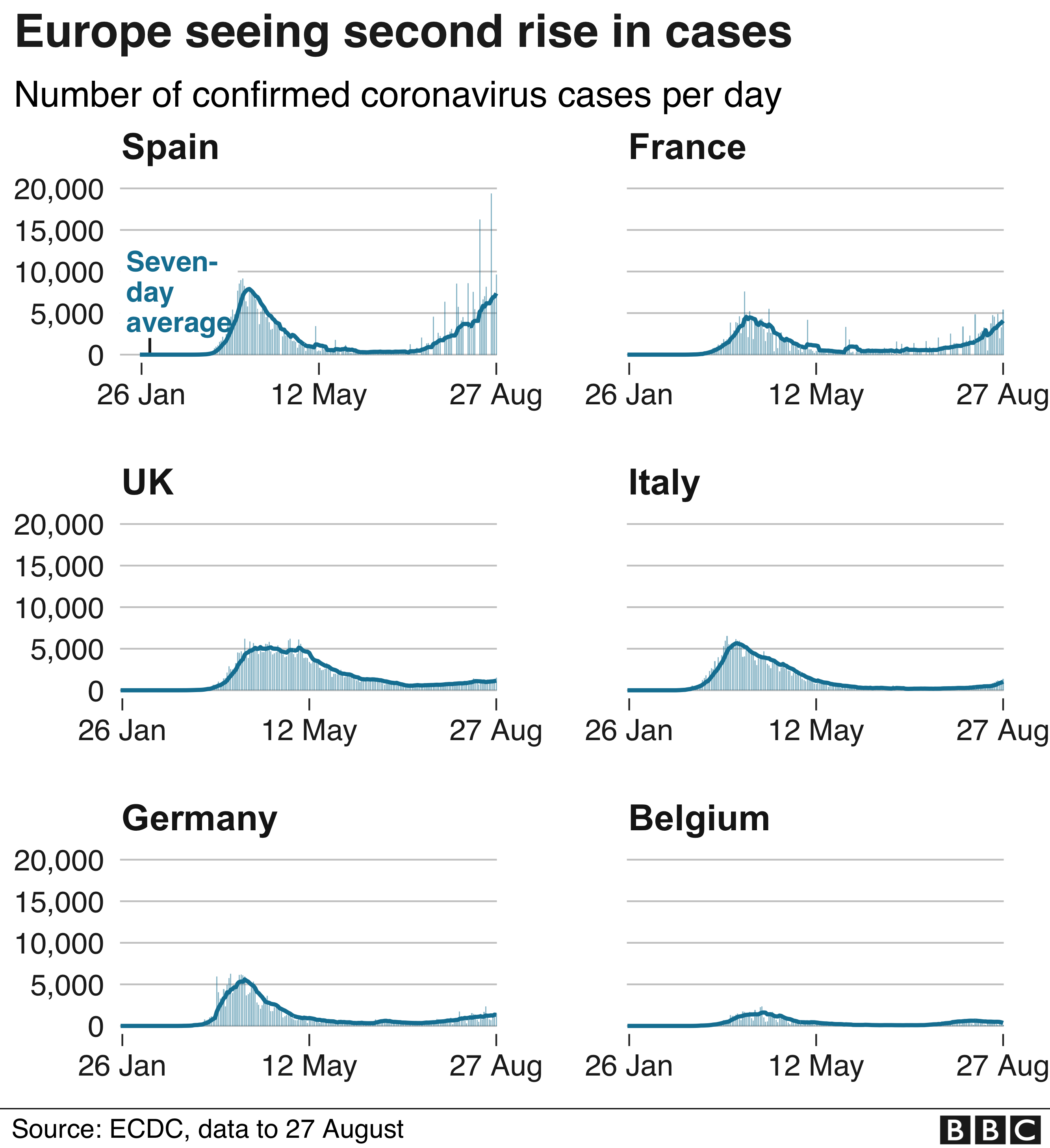
thisMoxley said:
Curious if these are taking place in different regions that dodged the original spike. That seems to be what happened in the US.
and 3rd and 4th until we all get it as it spreads to different geographic regions.Bruce Almighty said:
There was always going to be a second wave.
Quote:
Despite the sharp rise, hospital numbers and daily deaths were relatively stable, as young people less vulnerable to the disease make up most of the new infections, the ministry said.
EyeBalz said:
I don't care anymore.
We just need to go back to an almost complete pre-Covid normal, no masks, 100% capacity at restaurants but maybe something less for sports games , maybe restrict bars and nightclubs, and have high risk people stay home and/or wear N95 masks.
The goal should always be to not overwhelm our hospitals while protecting the very vulnerable, not to minimize total infections until a vaccine is available.
We are killing our the businesses that fuel our economy and wrecking our kids' Aggie college experience.
Ol_Ag_02 said:
Who cares. Stop being scared. Live your life.
I'm trying to understand this viewpointQuote:
We just need to go back to an almost complete pre-Covid normal, no masks, 100% capacity at restaurants but maybe something less for sports games , maybe restrict bars and nightclubs, and have high risk people stay home and/or wear N95 masks.
The goal should always be to not overwhelm our hospitals while protecting the very vulnerable, not to minimize total infections until a vaccine is available.
The large jump in cases we saw in Texas (and all southern states) was due to the seasonal nature of the virus, not the opening. Compare to California, which was way more restricted than Texas to Florida, but still had same trend.Sisyphus said:I'm trying to understand this viewpointQuote:
We just need to go back to an almost complete pre-Covid normal, no masks, 100% capacity at restaurants but maybe something less for sports games , maybe restrict bars and nightclubs, and have high risk people stay home and/or wear N95 masks.
The goal should always be to not overwhelm our hospitals while protecting the very vulnerable, not to minimize total infections until a vaccine is available.
After the restrictions started to roll back (but not as far as you're proposing), Texas started to approach hospital capacity in a lot of places (like Harris Country and the RGV). If we went back to "an almost complete pre-Covid normal, no masks, 100% capacity at restaurants" what keeps us from seeing the same thing? Is it that we're closer to herd immunity? Or are you saying we should open up and then pull back again when the numbers start to go up again? Something else?
Vintage Rifle for Sale: French Military issue Fusil MAS36 World War II rifle. Never been fired, only dropped once. $500.00 or best offer.BANA89 said:
France probably let them Covid walk right in over the border without putting up a fight.
Sisyphus said:
I agree that most coronaviruses are seasonal but they are worse in the winter not the summer. That would suggest that the seasonality aspect would make things worse than in the summer if we were to open up all the way now.
California's surge was about half of Texas on a per-capita basis (from eye-balling the charts here: https://www.nytimes.com/interactive/2020/us/coronavirus-us-cases.html?action=click&module=Top%20Stories&pgtype=Homepage, go down to the "where cases are decreasing" section) and places like the Bay Area where people complied with the restrictions had much smaller surges than places where they didn't, like the Central Valley.
(edit to take out an accidental emoji)
The concerned citizen in me wants to open everything back up and just take our lumps because the economic fallout from what's been shutdown so far is likely worse than the virusSisyphus said:I'm trying to understand this viewpointQuote:
We just need to go back to an almost complete pre-Covid normal, no masks, 100% capacity at restaurants but maybe something less for sports games , maybe restrict bars and nightclubs, and have high risk people stay home and/or wear N95 masks.
The goal should always be to not overwhelm our hospitals while protecting the very vulnerable, not to minimize total infections until a vaccine is available.
After the restrictions started to roll back (but not as far as you're proposing), Texas started to approach hospital capacity in a lot of places (like Harris Country and the RGV). If we went back to "an almost complete pre-Covid normal, no masks, 100% capacity at restaurants" what keeps us from seeing the same thing? Is it that we're closer to herd immunity? Or are you saying we should open up and then pull back again when the numbers start to go up again? Something else?
There's a fair amount of data that contradicts that. New Orleans was hit hard in the initial wave. LA was hit harder than the Bay Area in the initial wave and in the second surge. The Modesto area in California had really high numbers through the late summer while the Bay Area had relatively low numbers and most of the Bay Area is at the same latitude as Modesto and are about 50 miles apart. Iowan and the Dakotas are seeing big surges right now and they're at high latitudes.I see a much higher correlation with resistance to restrictions and mask wearing.Quote:
Even so you have to admit latitude and climate play a huge part in how this spreads.
The last I saw Sweden's GDP had dropped as much as its Scandinavian neighbors but they had a death toll 10X higher. But that was months ago and I haven't really been following them. If you have a link handy showing their economy rebounding faster than their neighbors, I'd like to read it.Quote:
Sweden let in run, should have protected elder homes better, but they are now looking very good now and their economy hasn't been hit near as bad as it's neighbors.
Quote:
One thing stated early on was that these novel virus pandemics (1918, late 50's, late 60's, 2009) usually last 10-18 months globally, we are about at 10 months and I think on the downside of incident rate and impact.
