ABATTBQ87 said:
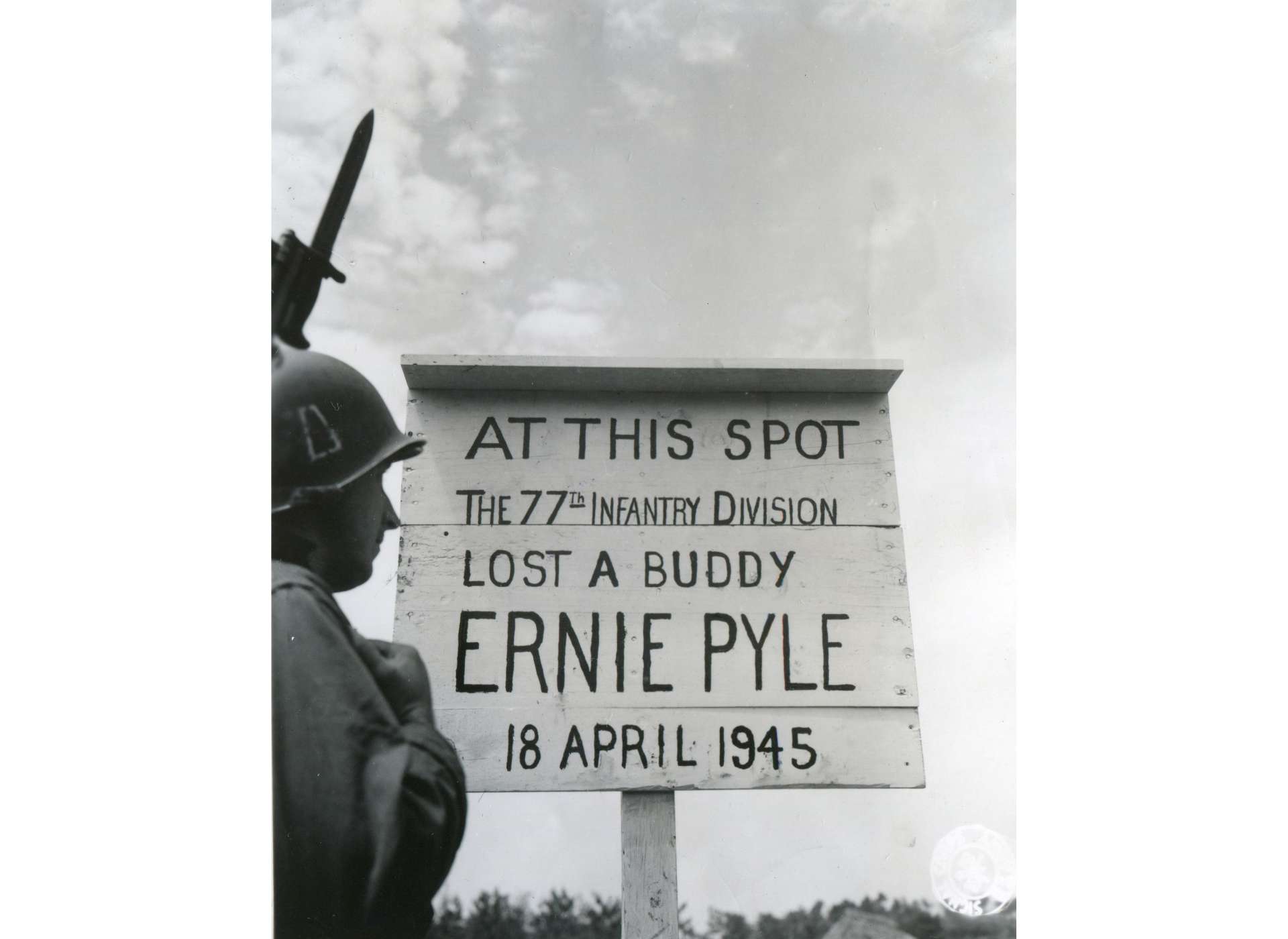
On April 18, 1945, just six days after President Franklin Roosevelt succumbed to a fatal stroke, a bullet from a Japanese machine gun prematurely ended the 44-year-old journalist's life. In less than a week, Americans everywhere found themselves collectively mourningand publicly commemoratingthe loss of two national heroes.
"The death of Ernie Pyle this week was a real loss to every soldier everywhere. He understood the soldier and presented his case to the public as nobody else had done during the war."
Given Pyle's immense popularity with both citizens and troops, it is unsurprising that news of his sudden death sparked a global outpouring of love and spurred numerous plans to memorialize his life. Incredulous callers flooded newsroom switchboards and correspondence deluged mail rooms. One wounded vet suggested changing the name of Ie Shima to Ernie Pyle Island, and a Captain in the Army proposed renaming Okinawa itself in Pyle's honor. Though these grandiose plans never materialized, memorials soon sprang up from Japan to Germany.
The Battalion April 19, 1945
MONTY PYTHON AND THE HOLY GRAIL was released 51 years ago today.
— cinesthetic. (@TheCinesthetic) April 28, 2026
Led Zeppelin invested £31,500 for the filming, Pink Floyd put in £21,000, & Ian Anderson contributed £6,300, because no studio would fund a comedy about King Arthur and the Holy Grail. pic.twitter.com/XynSLp09F3
BQ78 said:
Stoneman begins his raid that will also end badly but kicks off the Chancellorsville Campaign.
2nd of 1945 Battle of Berlin ends as the Soviet army storms the capital, forcing German commander of the city, General Helmuth Weidling, to surrender pic.twitter.com/RXztCw4Wnn
— Benjamin.Uz (@BenjaminUz48674) May 2, 2026
BonfireNerd04 said:
1862: A Mexican army led by General Ignacio Zaragoza successfully defended a fort near Puebla against an attack by French troops, thus creating an annual excuse for Mexico to sell alcoholic beverages to gringos.
Quote:
Certain that French victory would come swiftly in Mexico, roughly 6,000 French troops under General Charles de Lorencez set out in May 1862 to attack Puebla de Los Angeles. From his new headquarters in the north, Juarez rounded up a ragtag force of loyal men and sent them to Puebla. Meanwhile, Mexican General Ignacio Zaragoza led an estimated 2,000 to 5,000 Mexicans as they fortified the town and prepared for the assault by the well-equipped French force.
162 years ago today, on May 4, 1864, Ulysses S. Grant pushed 118,000 men across the Rapidan River into the tangled thickets of the Wilderness, and the Civil War changed forever.
— Echoes of War (@EchoesofWarYT) May 5, 2026
For three years, the Army of the Potomac had been a revolving door of cautious generals. McClellan.… pic.twitter.com/rqWTzeXgjs
Quote:
Her name is Joan of Arc, a 17-year-old from the tiny village of Domremy. She claims to hear voices from saints, divine messages urging her to save France. Against all odds, she's convinced the dauphin, Charles VII, to let her lead troops to Orleans. When she arrives in late April, clad in armor and riding a white horse, the soldiers and townsfolk are skeptical. A girl leading an army? Unheard of. Yet her unshakable convictionher certainty that God has sent herignites a spark in their weary hearts.
By May 8, after days of fierce fighting, Joan's leadership proves decisive. She rallies the French troops to attack the English fortifications, personally scaling ladders under a hail of arrows. At one point, she's wounded by a crossbow bolt to the shoulder, yet she refuses to retreat, her banner waving defiantly. Her courage is infectious. The French soldiers, inspired by this fearless maiden, push harder than ever. By the end of the day, the English are in full retreat, abandoning their siege. Orleans is saved.
May 9, 1864. A small mountain in southwestern Virginia. A 90-minute battle nobody remembers. And on this one hillside, on this one afternoon, fought TWO future Presidents of the United States.
— Echoes of War (@EchoesofWarYT) May 10, 2026
Union Colonel Rutherford B. Hayes, the 19th President, led the 23rd Ohio in a bayonet… pic.twitter.com/dJ52IiRulp
Quote:
May 9, 1864. A small mountain in southwestern Virginia. A 90-minute battle nobody remembers. And on this one hillside, on this one afternoon, fought TWO future Presidents of the United States.
Union Colonel Rutherford B. Hayes, the 19th President, led the 23rd Ohio in a bayonet charge across Back Creek under murderous Confederate fire. The water was waist-deep. The far bank was a wall of muzzle flashes. Men dropped into the current and were swept downstream.
Beside him, holding the line, fought a 21-year-old commissary sergeant named William McKinley, the 25th President. The man who would, decades later, be shot dead in Buffalo by an anarchist's revolver.
The fighting on Cloyd's Mountain became some of the most savage close-quarters combat of the entire war. Ammunition ran out. Men reversed their muskets and clubbed each other with the butts. They fought with bayonets, knives, fists, rocks. Confederate Brigadier General Albert Jenkins was hit, his shattered arm amputated on the field. He died of infection two weeks later, refusing to leave his men.
By dusk, the Confederate line had collapsed. The 23rd Ohio kept marching. Days later, Crook's army burned the Virginia & Tennessee Railroad bridge across the New River, the longest bridge in the Confederacy, and gutted the South's western supply line.
Two future presidents. One bloody Virginia hilltop. A 90-minute fight that history almost entirely forgot.
81 years ago today, Captain Lewis Nixon of the 101st Airborne Division slowly gets up the morning after celebrating VE-Day with fellow officers of the Battalion. 🪂
— J&L Historical (@Jason_R_Burt) May 9, 2026
The source of all those bottles was the wine cellar of Reichmarshall Hermann Göring. 🍾 pic.twitter.com/61dmxjRBnz
On this day in 1960, the USS Triton surfaces off the coast of Delaware having completed history's first submerged circumnavigation of the globe. It has taken the nuclear-powered sub 60 days to complete the voyage. pic.twitter.com/J5M4gIlFSl
— Military History Now (@MilHistNow) May 10, 2026
2Legit_92 said:
Wanted to post this yesterday….
May 9, 1989 - Keith Whitley passed away from alcohol poisoning. Those 37 years since then went by way too quickly. His career was cut way too short.
Today marks the 157th anniversary of the driving of the Golden Spike – a defining moment in rail history.
— Union Pacific (@UnionPacific) May 10, 2026
As Big Boy #up4014 prepares to steam eastward, Union Pacific’s Silver Spike is along for the ride, honoring that legacy while commemorating America’s 250th anniversary –… pic.twitter.com/vBKnRUoGE8
May 11, 1976. A tanker carrying 7,500 gallons of liquid ammonia crashed onto a Houston freeway, killing six and injuring more than 170. Fifty years later, we remember. Video courtesy @abc13houston #HoustonFire #HoustonHistory #HazMat pic.twitter.com/b2JL4de0wj
— Houston Fire Dept (@HoustonFire) May 11, 2026