WSJ report on corona safety in stadiums featuring Kyle Field

8,597 Views | 106 Replies | Last: 5 yr ago by cone
beerad12man
How long do you want to ignore this user?
AG
I wouldn't bet my life savings on it, but call it a hunch. I think there's a better chance than reading through this thread would indicate.

Okay, maybe some more stay home out of fear so it isn't exactly 100K, but rather 75K actually attend. 100k was just an exaggeration to say I think it will be fully open and anyone can attend.
cone
How long do you want to ignore this user?
AG
i will still take that bet

of it being wide open, no restrictions, no required distancing in the stands
tysker
How long do you want to ignore this user?
AG
Proposition Joe said:

tysker said:

Proposition Joe said:

tysker said:

Quote:

the amount of time left to make the decision continues to dwindle that we might have to plan for reduced capacity
Are you a season ticket holder? Are you willing to give up your seats? We have a loge box which is almost completely socially distanced from others by design. The suites are socially distanced. By mid-Sept most students will have already been exposed and likely immune. How does anyone redesign seating to make it equitable? Telling 50% of season ticket holders that they cant attend the LSU game when A&M may be playing for its first 10-win season in forever, is a non-starter. Attendance seems like an all or none deal.

If you are approaching this from the viewpoint that it's "all or none" then you aren't approaching this from a logical viewpoint.

Obviously reduced attendance is not something anyone wants. Obviously reduced attendance is a logistical headache.

But this idea that these athletic departments are going to say "we aren't willing to accept 30-50% of the gate, we'll just deal with 0% gate" isn't logical. It's in no way "all or nothing" and our athletic director literally says as much in the linked video.

As for how you handle season ticket holders in that situation - you refund/credit them and sell the reduced capacity games as single games.
I'm trying to approach from a pragmatic and equitable vantage point. Are selling your ticket back? How are ADs going to "force" reduction of reserved seating? If you were around for the Kyle Field reseating lawsuits for endowed donors, you know people will fight for what they think they are due.

See above. It's easy. Refund/Credit all season ticket holders. Sell reduced capacity games as season tickets (as this allows you to modify seat select to only allow certain seats). Offer season ticket holders an earlier presale for the individual games.
Easy, really? Much easier to type it than actually implement and afford it. I guess you think the TMF is going to make it fair and equitable? The only way I see it as monetarily equitable would be significantly reducing student capacity which is opposite of what the health data suggests. Fair is fair, right?

Are you giving up your tickets and place in line?
Ranger222
How long do you want to ignore this user?
AG
twk said:

Having 65000 students in residence is going to create a lot greater risk of an outbreak in BCS than having football games with fans would. The students come from all over and live in close quarters. There almost certainly will be spread among the student and staff population, with or without football. The greater risk from the football game is that you get fans who travel in for the game, and spread it to fans who travel to other locations, so you take what might have been a localized outbreak and spread it to multiple locations.

What the decision makers are starting to come to grips with is that we cannot eliminate risk, and instead, have to find a tolerable level of risk given the need for life (and business) to carry on. Although there will be restrictions continuing for some time, we will do things this Fall that seem unthinkable to some people right now.

I think you will be surprised in that almost all students will be tested in returning to campus this fall. They will not be able to attend classes without being tested. Employees at universities are doing it now and it will be first applied to professional students, then grad students and finally the broader undergraduate population as they return in August. That pretty must takes this risk away easily, and makes it fairly manageable.

You cannot, however, test everyone coming into a college town for a football game and all 70+ thousand non-student attendees at Kyle Field.

I agree that risk cannot be eliminated, but the tolerable level of risk may not suit your or others desires, and something we all must accept moving forward.
Jbob04
How long do you want to ignore this user?
AG
Ranger,
You speak in a lot of absolutes and stating things as if they are facts when none of this has been released. Are you high up in the administration?
tysker
How long do you want to ignore this user?
AG
Ranger222 said:

twk said:

Having 65000 students in residence is going to create a lot greater risk of an outbreak in BCS than having football games with fans would. The students come from all over and live in close quarters. There almost certainly will be spread among the student and staff population, with or without football. The greater risk from the football game is that you get fans who travel in for the game, and spread it to fans who travel to other locations, so you take what might have been a localized outbreak and spread it to multiple locations.

What the decision makers are starting to come to grips with is that we cannot eliminate risk, and instead, have to find a tolerable level of risk given the need for life (and business) to carry on. Although there will be restrictions continuing for some time, we will do things this Fall that seem unthinkable to some people right now.

I think you will be surprised in that almost all students will be tested in returning to campus this fall. They will not be able to attend classes without being tested. Employees at universities are doing it now and it will be first applied to professional students, then grad students and finally the broader undergraduate population as they return in August. That pretty must takes this risk away easily, and makes it fairly manageable.

You cannot, however, test everyone coming into a college town for a football game and all 70+ thousand non-student attendees at Kyle Field.

I agree that risk cannot be eliminated, but the tolerable level of risk may not suit your or others desires, and something we all must accept moving forward.
How often will students and staff be tested? One test tells us nothing. For students and staff that have already been affected, will they have to be tested as well? I can see temps being taken while entering buildings but that only leads to long lines where social distancing is hard to maintain thus negating the purpose.

The students know such practices are theater; they have highly tuned BS detectors.
twk
How long do you want to ignore this user?
AG
tysker said:

twk said:

tysker said:

Quote:

the amount of time left to make the decision continues to dwindle that we might have to plan for reduced capacity
Are you a season ticket holder? Are you willing to give up your seats? We have a loge box which is almost completely socially distanced from others by design. The suites are socially distanced. By mid-Sept most students will have already been exposed and likely immune. How does anyone redesign seating to make it equitable? Telling 50% of season ticket holders that they cant attend the LSU game when A&M may be playing for its first 10-win season in forever, is a non-starter. Attendance seems like an all or none deal.

I do think it would be difficult to do social distancing with season ticket holders. Even if you just went down the list by priority points, you'd end up with people in club seating stuck in the bleachers somewhere, and then wanting a refund given the difference in level of seating. For that reason, if we do have to have social distancing in the Fall (and that is not a certainty), then for A&M, it seems to me the thing to do is just have students in attendance. You can spread them out, and they draw tickets the week of the game. They are actually the perfect population for doing this.
Then the AD is returning millions of dollars back to donors and allowing students (who pay half price tickets, pay no PSL and don't spend as much money on concessions) to attend in person? While logical it seems as pragmatic as restaurants opening with 25% capacity. Donors may feel cheated given this inequitable solution. If donors stop going to games are they going back? ADs need to think about the long-run too.
Yes, they will not enjoy giving money back, but the alternative seems too brutal to contemplate. If they adopt the same policy that they did for Spring sports, my guess is that a large percentage of season ticket holders would have the refund applied to next years tickets, so that the hit is effectively spread over two years. If everyone is treated the same, at least they won't have to worry about inequitable treatment, and I can't imagine any former students being upset if current students are the only ones allowed to attend due to social distancing.

Again, I think there is a fair chance that we play with a full stadium in the Fall, but if we don't, it's hard for me to picture how we would parcel out tickets other than by limiting it to students.
Proposition Joe
How long do you want to ignore this user?
tysker said:

Proposition Joe said:

tysker said:

Proposition Joe said:

tysker said:

Quote:

the amount of time left to make the decision continues to dwindle that we might have to plan for reduced capacity
Are you a season ticket holder? Are you willing to give up your seats? We have a loge box which is almost completely socially distanced from others by design. The suites are socially distanced. By mid-Sept most students will have already been exposed and likely immune. How does anyone redesign seating to make it equitable? Telling 50% of season ticket holders that they cant attend the LSU game when A&M may be playing for its first 10-win season in forever, is a non-starter. Attendance seems like an all or none deal.

If you are approaching this from the viewpoint that it's "all or none" then you aren't approaching this from a logical viewpoint.

Obviously reduced attendance is not something anyone wants. Obviously reduced attendance is a logistical headache.

But this idea that these athletic departments are going to say "we aren't willing to accept 30-50% of the gate, we'll just deal with 0% gate" isn't logical. It's in no way "all or nothing" and our athletic director literally says as much in the linked video.

As for how you handle season ticket holders in that situation - you refund/credit them and sell the reduced capacity games as single games.
I'm trying to approach from a pragmatic and equitable vantage point. Are selling your ticket back? How are ADs going to "force" reduction of reserved seating? If you were around for the Kyle Field reseating lawsuits for endowed donors, you know people will fight for what they think they are due.

See above. It's easy. Refund/Credit all season ticket holders. Sell reduced capacity games as season tickets (as this allows you to modify seat select to only allow certain seats). Offer season ticket holders an earlier presale for the individual games.
Easy, really? Much easier to type it than actually implement and afford it. I guess you think the TMF is going to make it fair and equitable? The only way I see it as monetarily equitable would be significantly reducing student capacity which is opposite of what the health data suggests. Fair is fair, right?

Are you giving up your tickets and place in line?

They would make it "fair and equitable" based on the exact system that they have been telling people priority decisions would be made for the last 20 years -- priority points. Individual game selections would be as fair and equitable as seat selection/upgrades.

Will some not make the cut? Absolutely... But it's better than any kind of alternative approach where you talk to each season ticket holder and try and find them a "fair" re-seating or try and negotiate with each season ticket holder on what their refund should be (or this silly idea of you get games 1 and 2, you get games 3 and 4, etc...). That's simply a logistical nightmare that makes little sense to attempt. We saw how that worked out with new Kyle with a year+ to negotiate. With 2-3 months? Not a chance they'd even try.

You refund/credit, sell as individual game tickets at already mapped out reduced capacity (no one can select/buy any seats that you are not using) and if you think it's feasible based on demand for that reduced capacity to increase those single game prices then that allows you to make back some of that money on the year.

As for giving up my tickets, I wouldn't be giving them up. In a reduced capacity situation they would be refunded/credited.

As for giving up my place in line -- I would accept whatever place for individual game tickets that my priority put me at. I'm high enough that I wouldn't have to worry about getting left out though.
beerad12man
How long do you want to ignore this user?
AG
BadMoonRisin said:

PJYoung said:

GAC06 said:

I would go to a stadium or concert now if I could, as the virus poses about as much threat to me as driving there from my house.

Except this isn't about you. (and I know that simple fact is so very hard to understand in 2020)
Im so sick of hearing this. Olds and fats have had 2.5 months to learn that they need to not go to these events. Everyone else is fine.

No, you are not a murderer if you catch China flu and give it to someone else.
This is probably the wrong board for that post and you may get some backlash.....

But as harsh as it sounds, I do tend to agree with you. I'm all about keeping us under the medical capacity. As a society, we likely need to make some sacrifices to do so. But at the end of the day, it should be about each individual controlling their own risks as best they can with as much information as they can.

Where exactly the line is drawn for the rest of us at minimal risk, I don't know. What amount of deaths are acceptable to each individual before returning to our old normal? IDK. When exactly this became about saving every life possible rather than just keeping us under the curve so as not to overwhelm our medical staff/supplies, again, I don't know. Why is it okay to lose 50k to the flu any given year without taking any kind of extra measures, but if we can take measures like wearing masks, social distancing, and shutting businesses down long term, maybe we could save an extra 50k to this even though that isn't proven? IDK. Maybe we saved 50k lives doing this. Maybe we saved a million. Or maybe the same lives would have all been lost, just spread out over different/longer timelines. IDK.

All life takes on risk. The risk just went up for everyone, but for most, a negligible amount.

I'll change my tune if 1 of 3 things happen:

1) There's some more promise and damn near a guarantee of a HUMAN vaccine. No, not just an antibody like STI-1944 that supposedly works but has never even been proven on animals let alone humans.

2) Treatments promise to become much more effective thus continuing to reduce the true IFR. Lets say hypothetically, we are at 0.6 and can realistically get that to 0.1 with further research of slowing this thing down, okay then I get some of the point of delaying this.

3) It truly looks like we are about to overwhelm our hospitals. This really is the biggest key. Obviously we can't let this happen. I just don't think we are in true danger of doing so other than maybe a few hot spots like NYC where the lifestyle tends to be a haven for these types of viruses.

Otherwise, we are just delaying the inevitable and it's likely the same people will get it that do, and the same people will die that do. Just on different timelines depending on behavior. Again, as harsh as that sounds.

twk
How long do you want to ignore this user?
AG
Quote:

I think you will be surprised in that almost all students will be tested in returning to campus this fall. They will not be able to attend classes without being tested. Employees at universities are doing it now and it will be first applied to professional students, then grad students and finally the broader undergraduate population as they return in August. That pretty must takes this risk away easily, and makes it fairly manageable.
65000 students may be tested, at some point, but not on an ongoing basis. You aren't going to be able to test once, then lock down that large of a population and prevent the virus from spreading, absent some real draconian actions that aren't conceivable in a democracy. But it's OK, because the virus poses comparatively little risk to this population.

You can't shelter your way past this virus indefinitely.
Get Off My Lawn
How long do you want to ignore this user?
There's no reason for the student population to care about this thing. Heck - the best possible outcome is that COVID-19 takes the school by storm and they all work through it before Thanksgiving. Unhealthy college aged kids should probably weigh the risks with the assumption that they'll catch the Wuhan (eta on campus - with or without football).

Former students should expect exposure on campus and plan accordingly. If they're healthy and not living with high risk individuals - then bring it on. If their risk assessment comes up Tails: refund those season tickets.

Heck - we could expand student seating and keep the student side isolated. Or hand the game back to the students: 50k students yelling on one side with concrete echoing it back. Could be even louder than 90% of the time that old Ags are present!
Bocephus
How long do you want to ignore this user?
AG
Ranger222 said:

While an open air stadium in the heat and humidity of Texas certainly has advantages to reduce transmission, we also have to remember the high likelihood of aerosol transmission of the virus, and what is one thing we are known for -- yelling.


https://www.cdc.gov/mmwr/volumes/69/wr/mm6919e6.htm

Another thing to consider.


How many of those people died?
TAMU ‘98 Ole Miss ‘21
The Shank Ag
How long do you want to ignore this user?
If you dont want to risk it, sell your ticket.
Carnwellag2
How long do you want to ignore this user?
CT75 said:

culdeus said:


There is no method/enforcement to make high risk people stay home, that's the issue. Because we have selfish high risk people, nobody gets to go.

Having been to quite a few TAMU games lately, the entire 2nd deck is just jammed full of high risk people that paid a crap ton for those seats and PSL. No way we can get them to stay home while the millenials go in their place, none.
What if the high risk people understand the risks and want to go vs. hide under their beds? Why does that make them selfish...why is the government trying to protect them if they understand the risks and want to go?

Are you saying they have a high-risk of dying from the virus? If they want to go and understand the risks...let them go.

agreed - people make risk calculations everyday in determining what activities to do. Why is this different?
Carnwellag2
How long do you want to ignore this user?
BowSowy said:

cone said:

schools will not be open five days a week for students, at least not HISD

it'll be A/B schedule at the most
You don't know that, at all. Quit presenting your opinions as if they are facts.
exactly - posts like the above are one of the reasons that we will be extremely slow to reopen. spreading opinion as fact and creating fear
Carnwellag2
How long do you want to ignore this user?
PJYoung said:

Aggie said:

GAC06 said:

I would go to a stadium or concert now if I could, as the virus poses about as much threat to me as driving there from my house.


Statistically.... driving there poses much more of a threat


In April Covid-19 was the 3rd leading cause of death in the US behind cancer and heart disease.
to be fait to the above - how much highway driving was happening in April. We were all locked away with no commuting
PJYoung
How long do you want to ignore this user?
AG
Bocephus said:

Ranger222 said:

While an open air stadium in the heat and humidity of Texas certainly has advantages to reduce transmission, we also have to remember the high likelihood of aerosol transmission of the virus, and what is one thing we are known for -- yelling.


https://www.cdc.gov/mmwr/volumes/69/wr/mm6919e6.htm

Another thing to consider.


How many of those people died?

How many of those people now have life long disabilities because of the virus?
tysker
How long do you want to ignore this user?
AG
PJYoung said:

Bocephus said:

Ranger222 said:

While an open air stadium in the heat and humidity of Texas certainly has advantages to reduce transmission, we also have to remember the high likelihood of aerosol transmission of the virus, and what is one thing we are known for -- yelling.


https://www.cdc.gov/mmwr/volumes/69/wr/mm6919e6.htm

Another thing to consider.


How many of those people died?

How many of those people now have life long disabilities because of the virus?
How many had life long disabilities before the virus? What if you have the cause and effect backwards?
PJYoung
How long do you want to ignore this user?
AG
tysker said:

PJYoung said:

Bocephus said:

Ranger222 said:

While an open air stadium in the heat and humidity of Texas certainly has advantages to reduce transmission, we also have to remember the high likelihood of aerosol transmission of the virus, and what is one thing we are known for -- yelling.


https://www.cdc.gov/mmwr/volumes/69/wr/mm6919e6.htm

Another thing to consider.


How many of those people died?

How many of those people now have life long disabilities because of the virus?
How many had life long disabilities before the virus? What if you have the cause and effect backwards?

I was referring to the doctor on here that talked about healthy 30 and 40 year olds that will live with what this virus did to their bodies for the rest of their lives. As in, life long medical care.

This virus has been portrayed as death or you're recovered and fine but for thousands of previously healthy individuals that's not true.
cone
How long do you want to ignore this user?
AG
beerad12man
How long do you want to ignore this user?
AG
PJYoung said:

tysker said:

PJYoung said:

Bocephus said:

Ranger222 said:

While an open air stadium in the heat and humidity of Texas certainly has advantages to reduce transmission, we also have to remember the high likelihood of aerosol transmission of the virus, and what is one thing we are known for -- yelling.


https://www.cdc.gov/mmwr/volumes/69/wr/mm6919e6.htm

Another thing to consider.


How many of those people died?

How many of those people now have life long disabilities because of the virus?
How many had life long disabilities before the virus? What if you have the cause and effect backwards?

I was referring to the doctor on here that talked about healthy 30 and 40 year olds that will live with what this virus did to their bodies for the rest of their lives. As in, life long medical care.

This virus has been portrayed as death or you're recovered and fine but for thousands of previously healthy individuals that's not true.
I would bet it's a very, very low percentage. Similar to that of the flu causing long term damage. Of course over millions of cases, there will be some. Just like the flu. For younger individuals, the death rate of COVID 19 seems like it is going to fall well in line with that of the flu, so I have a feeling the long term effects will, too.

tysker
How long do you want to ignore this user?
AG
PJYoung said:

tysker said:

PJYoung said:

Bocephus said:

Ranger222 said:

While an open air stadium in the heat and humidity of Texas certainly has advantages to reduce transmission, we also have to remember the high likelihood of aerosol transmission of the virus, and what is one thing we are known for -- yelling.


https://www.cdc.gov/mmwr/volumes/69/wr/mm6919e6.htm

Another thing to consider.


How many of those people died?

How many of those people now have life long disabilities because of the virus?
How many had life long disabilities before the virus? What if you have the cause and effect backwards?

I was referring to the doctor on here that talked about healthy 30 and 40 year olds that will live with what this virus did to their bodies for the rest of their lives. As in, life long medical care.

This virus has been portrayed as death or you're recovered and fine but for thousands of previously healthy individuals that's not true.
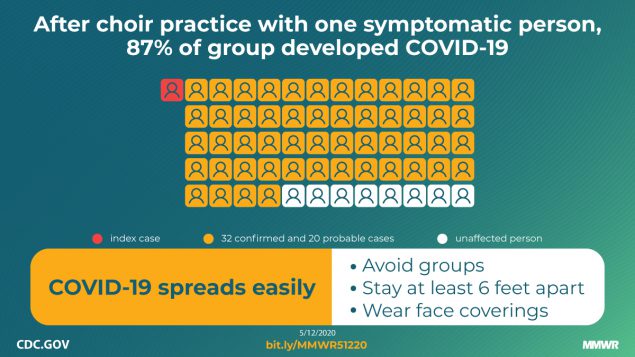
Thats not fair. You were questioning the amount of people that have life-long disabilities due to contracting COVID (edit) as it related to the choir outbreak in Washington at the beginning of March. And then you ask how many young people now have long-term post recovery issues from a disease that is problematic mostly for the elderly and generally unhealthy.

https://www.baltimoresun.com/coronavirus/sns-nyt-coronavirus-choir-20200517-xask2wwy4feohnjez6j2dvkapm-story.html
Quote:

The event, which was first reported by The Los Angeles Times in March, demonstrated how contagious and dangerous the coronavirus is, especially among older populations. The median age for those attending the practice that night was 69.
Given this information, how many 30-40 years old were in attendance that night?


Also as it relates to football game attendance, singing (yelling) may not be as clear a transmission vector. Proxmity matters more...
https://www.theguardian.com/world/2020/may/17/did-singing-together-spread-coronavirus-to-four-choirs

Quote:

"However, we also found out that singing is quite safe. It was not the cause of the outbreaks of Covid-19 at these concerts ," he said. "Air was only propelled about half a metre in front of a singer, and that is not far enough to cause the infection levels of these outbreaks."

Khler said the virus was probably spread among chorus members because of their close proximity to each other before and after rehearsals and performances. As he pointed out: "These outbreaks among choir members all occurred during the early days of the Covid-19 pandemic, before lockdowns were imposed and before our minds were concentrated on the importance of social distancing. Choir members probably greeted each other with hugs, and shared drinks during breaks and talked closely with each other. That social behaviour was the real cause of these outbreaks, I believe."

Fitch
How long do you want to ignore this user?
AG
No disrespect intended, but a gut feeling correlating a novel virus with a different family of viruses doesn't logically follow.

Mortality obviously increases with age, but the overall percentage of disaffected, non-lethal cases, seems to be a question mark at this point. That said, the reports that do trickle out seem to be pretty consistent that there are dramatically varying presentations of the disease at all (?) ages ranges. Maybe one of our resident docs can provide an anecdote?

FWIW, I agree it's likely a smaller %, but the range is dubious. Data drives decent discussions...
PJYoung
How long do you want to ignore this user?
AG
The_Fox said:

PJYoung said:

Bocephus said:

Ranger222 said:

While an open air stadium in the heat and humidity of Texas certainly has advantages to reduce transmission, we also have to remember the high likelihood of aerosol transmission of the virus, and what is one thing we are known for -- yelling.


https://www.cdc.gov/mmwr/volumes/69/wr/mm6919e6.htm

Another thing to consider.


How many of those people died?

How many of those people now have life long disabilities because of the virus?
Same as those that died. Zero. You are letting outliers influence your risk assessment. The doctors here were wrong about the risk posed by the virus, just like our government.

They were talking about their real, actual cases.

I appreciate them sharing their real-life experience with us here and I understand why they have mostly stopped.
PJYoung
How long do you want to ignore this user?
AG
tysker said:

PJYoung said:

tysker said:

PJYoung said:

Bocephus said:

Ranger222 said:

While an open air stadium in the heat and humidity of Texas certainly has advantages to reduce transmission, we also have to remember the high likelihood of aerosol transmission of the virus, and what is one thing we are known for -- yelling.


https://www.cdc.gov/mmwr/volumes/69/wr/mm6919e6.htm

Another thing to consider.


How many of those people died?

How many of those people now have life long disabilities because of the virus?
How many had life long disabilities before the virus? What if you have the cause and effect backwards?

I was referring to the doctor on here that talked about healthy 30 and 40 year olds that will live with what this virus did to their bodies for the rest of their lives. As in, life long medical care.

This virus has been portrayed as death or you're recovered and fine but for thousands of previously healthy individuals that's not true.
Thats not fair. You were questioning the amount of people that have life-long disabilities due to contracting COVID (edit) as it related to the choir outbreak in Washington at the beginning of March. And then you ask how many young people now have long-term post recovery issues from a disease that is problematic mostly for the elderly and generally unhealthy.

https://www.baltimoresun.com/coronavirus/sns-nyt-coronavirus-choir-20200517-xask2wwy4feohnjez6j2dvkapm-story.html
Quote:

The event, which was first reported by The Los Angeles Times in March, demonstrated how contagious and dangerous the coronavirus is, especially among older populations. The median age for those attending the practice that night was 69.
Given this information, how many 30-40 years old were in attendance that night?


Also as it relates to football game attendance, singing (yelling) may not be as clear a transmission vector. Proxmity matters more...
https://www.theguardian.com/world/2020/may/17/did-singing-together-spread-coronavirus-to-four-choirs

Quote:

"However, we also found out that singing is quite safe. It was not the cause of the outbreaks of Covid-19 at these concerts ," he said. "Air was only propelled about half a metre in front of a singer, and that is not far enough to cause the infection levels of these outbreaks."

Khler said the virus was probably spread among chorus members because of their close proximity to each other before and after rehearsals and performances. As he pointed out: "These outbreaks among choir members all occurred during the early days of the Covid-19 pandemic, before lockdowns were imposed and before our minds were concentrated on the importance of social distancing. Choir members probably greeted each other with hugs, and shared drinks during breaks and talked closely with each other. That social behaviour was the real cause of these outbreaks, I believe."


Yes I see now that I conflated the two. Sorry about that.

I was speaking in general terms with covid-19 that it's not that you either die or recover 100%.
dragmagpuff
How long do you want to ignore this user?
AG
cone said:


That 0.7% IFR keeps popping up everywhere.
The_Fox
How long do you want to ignore this user?
Fitch said:

The_Fox said:

PJYoung said:

Bocephus said:

Ranger222 said:

While an open air stadium in the heat and humidity of Texas certainly has advantages to reduce transmission, we also have to remember the high likelihood of aerosol transmission of the virus, and what is one thing we are known for -- yelling.


https://www.cdc.gov/mmwr/volumes/69/wr/mm6919e6.htm

Another thing to consider.


How many of those people died?

How many of those people now have life long disabilities because of the virus?
Same as those that died. Zero. You are letting outliers influence your risk assessment. The doctors here were wrong about the risk posed by the virus, just like our government.

Yes, I'm under 50.
SirLurksALot
How long do you want to ignore this user?
cone said:


Man, this chart is really a death blow to some posters. The vast majority of 80 year olds and the majority of 90+ have mild or asymptotic cases. The fatality rate for 90+ is only 10%. I wonder what the flu fatality rate for the 90+ is?
dragmagpuff
How long do you want to ignore this user?
AG
Comparing flu numbers from CDC website for the most recent finalized analysis (2017-2018) to this:

Flu Death rate (deaths over symptomatic illnesses) 65+: 0.8561%
COVID Death rate (deaths over all infections) 60+: 2.255%

They don't breakout the data as fine as the Spain data.
BowSowy
How long do you want to ignore this user?
AG
Is there a level of cases between "mild or asymptomatic" and "hospitalized"? The percentages don't add up and I feel like I'm missing something.

Edit: Just as I post that, I realize "mild or asymptomatic" means people who had it and never had a positive test recorded
greg.w.h
How long do you want to ignore this user?
AG
Ranger222 said:

twk said:

Having 65000 students in residence is going to create a lot greater risk of an outbreak in BCS than having football games with fans would. The students come from all over and live in close quarters. There almost certainly will be spread among the student and staff population, with or without football. The greater risk from the football game is that you get fans who travel in for the game, and spread it to fans who travel to other locations, so you take what might have been a localized outbreak and spread it to multiple locations.

What the decision makers are starting to come to grips with is that we cannot eliminate risk, and instead, have to find a tolerable level of risk given the need for life (and business) to carry on. Although there will be restrictions continuing for some time, we will do things this Fall that seem unthinkable to some people right now.

I think you will be surprised in that almost all students will be tested in returning to campus this fall. They will not be able to attend classes without being tested. Employees at universities are doing it now and it will be first applied to professional students, then grad students and finally the broader undergraduate population as they return in August. That pretty must takes this risk away easily, and makes it fairly manageable.

You cannot, however, test everyone coming into a college town for a football game and all 70+ thousand non-student attendees at Kyle Field.

I agree that risk cannot be eliminated, but the tolerable level of risk may not suit your or others desires, and something we all must accept moving forward.
There are concentration requirements and simple accuracy problems that especially affect the rapid tests. The antibody tests can only detect while antibodies are actively produced which will be within a period of time of exposure (let's imagine three months before in essence the information is archived in Type B cells.)

Testing's best use is to determine prevalence. It's second best use is to confirm treatment regime. The concept of an antibody passport is a terrible idea. Letting herd immunity get established while the vulnerable choose to take the risk is by far the superior choice. Don't guarantee their safety and tell the public cloth masks are security theater.

Let people choose liberty and let them choose freely.
BowSowy
How long do you want to ignore this user?
AG
Also, I'm not sure how this isn't garnering more excitement on here. It's more evidence that this thing is not a big deal for almost everyone. And even for the 80+ crew, it's hospitalization for only 15% of cases.

This person outlines their sources and the way they collected their data here:
ETFan
How long do you want to ignore this user?
SirLurksALot said:

cone said:


Man, this chart is really a death blow to some posters. The vast majority of 80 year olds and the majority of 90+ have mild or asymptotic cases. The fatality rate for 90+ is only 10%. I wonder what the flu fatality rate for the 90+ is?
Have I done my math wrong or does this still equate to 678k deaths if 50% of those over the age of 40 become infected? Using population stats from 2018.

Seems we should be prudent in our reopening strategies.

'Majority' is irrelevant when the minority is still a number in the multiple 100ks.
SirLurksALot
How long do you want to ignore this user?
ETFan said:

SirLurksALot said:

cone said:


Man, this chart is really a death blow to some posters. The vast majority of 80 year olds and the majority of 90+ have mild or asymptotic cases. The fatality rate for 90+ is only 10%. I wonder what the flu fatality rate for the 90+ is?
Have I done my math wrong or does this still equate to 678k deaths if 50% of those over the age of 40 become infected? Using population stats from 2018.

Seems we should be prudent in our reopening strategies.

'Majority' is irrelevant when the minority is still a number in the multiple 100ks.


Not really. Those are acceptable losses.
ETFan
How long do you want to ignore this user?
BowSowy said:

Also, I'm not sure how this isn't garnering more excitement on here. It's more evidence that this thing is not a big deal for almost everyone. And even for the 80+ crew, it's hospitalization for only 15% of cases.

This person outlines their sources and the way they collected their data here:
30% infection rate in those over 80 years old would be 570k hospitalizations. I don't know if hospitalization in these stats means beds, but if it does, we only have about 1 million in the united states.


Just trying to put these 'small' numbers in perspective.
 
×
subscribe Verify your student status
See Subscription Benefits
Trial only available to users who have never subscribed or participated in a previous trial.