Extracted video from one of the articles above. This doctor and the nursing home exec are heroes.
Texas City Nursing Home
Texas City Nursing Home
Quote:
She also mentioned that hydroxychloroquine had been extensively appropriated in some European countries and the U.S. According to her, no fatalities caused by hydroxychloroquine have been reported yet. She went on to say that given the risks and benefits hydroxychloroquine is used in a COVID-19 patient for five days.
She insisted good results had been observed after the treatment with hydroxychloroquine. That is why, in her words, it is included in the medical protocol.

Quote:
Conclusion
Although this is a retrospective analysis, results suggest that early diagnosis, early isolation and early treatment of COVID-19 patients, with at least 3 days of HCQ-AZ lead to a significantly better clinical outcome and a faster viral load reduction than other treatments.
Quote:
"Treatment with HCQ-AZ was associated with a decreased risk of transfer to ICU or death (Hazard ratio (HR) 0.18 0.110.27), decreased risk of hospitalization 10 days (odds ratios 95% CI 0.38 0.270.54) and shorter duration of viral shedding (time to negative PCR: HR 1.29 1.171.42). QTc prolongation (>60ms) was observed in 25 patients (0.67%) leading to the cessation of treatment in 12 cases including 3 cases with QTc> 500ms. No cases of torsade de pointe or sudden death were observed."
"Although this is a retrospective analysis, results suggest that early diagnosis, early isolation and early treatment of COVID-19 patients, with at least 3 days of HCQ-AZ lead to a significantly better clinical outcome and a faster viral load reduction than other treatments."
Quote:
June 5, 2020 (LifeSiteNews) This is Part II of an astonishing 2-part article by LifeSite's Paris correspondent Jeanne Smits on the "spectacular" results doctors have seen treating covid-infected patients with a drug that powerful forces are trying to stop from saving lives. See Part I here.
~break~
South Korea, which was widely recognized for quickly containing the virus with measures such as massive testing and contact tracing, also included hydroxychloroquine as one of several drugs in its recommended treatment protocol. Since the first recorded cases on February 16, total cases reached 11,344 on May 28, with only 269 deaths. With its 51 million inhabitants and level of development, the country is comparable to France (67 million inhabitants) where the death toll is more than 100 times higher.
~break~
Prof. Raoult was probably also under fire because from the start, he criticized the "mediaeval" method of confinement, insisting that the only possible way to stop an epidemic is to test, isolate those who test positive and do everything possible to treat them and prevent them from dying. "We've tried confinement in Marseille, and it didn't work," he said, with reference to the cholera plagues that affected that city in the 1800's.
He noted that in Spain, a study of coronavirus prevalence among people who were confined at home and those who went out to work showed that workers showed a lower contamination rate by the virus than people who "sheltered in place."
~break~
Marseille was the one place in France where most tests were done, but it was also the place where the number of deaths in proportion to the population compared with other regions of France with comparable rates of contamination was lowest. Before the epidemic started off, Marseille was expected to be one of the epicenters of the coronavirus, according to reliable sources from the French Ministry of the Interior.
Marseille is one of the main centers of African immigration. The northern parts of the city are large "ethnic suburbs" where confinement was next to impossible to enforce, as was the case in the northern suburbs of Paris where COVID-19 led to a higher death rate than elsewhere in France under government guidelines no testing, no treating. However, testing and treating as recommended by Raoult in Marseille appears to have avoided a similar outcome.
~break~
In the May 19 video, Raoult observed that the death rate in France per 1 million inhabitants is now officially at 419, "which is a lot," Raoult stated. He recalled that in the east of France, the death rate was of 600 per 1 million inhabitants, and 500 in the greater Paris region, and even 759 in Paris proper. At the same time, in the region of Marseille (Provence, Alps and Cte d'Azur) the death rate was only 168 per 1 million inhabitants, and 140 in Marseille proper. In other words, five times more coronavirus-infected people died in Paris than in Marseille.
At the IHU itself, where treatment with HCQ and azithromycin was given to a majority of 4,000 treated patients (some refused, others could not receive it for various reasons, mostly because it was too late for it to save them) the mortality rate was of 0.5 percent of infected patients. On May 27, a total of 3,313 patients had been treated at IHU with the HCQ-azithromycin protocol; only 18 of them had died.
Raoult's IHU-Mditerrane institute has recently published an English abstract of its "real-life cohort of 3,737 patients," showing "a decreased risk of transfer to the ICU or death," available here.
~break~
Raoult's experience is matched by that of a US physician, Dr. Stephen Smith, an infectious disease specialist. He also called the HCQ treatment an "absolute game-changer." At the beginning of April he told Fox News that he had seen "100 percent success" treating 72 seriously ill COVID-19 patients with HCQ and azithromycin: "I think this is the beginning of the end of the pandemic."
It was he who briefed Donald Trump about the treatment. By May 20, he was telling WND about his "frustration" at seeing the safety of the treatment being questioned. "There's just a craziness out there, and I don't know how to correct it," Smith said according to WND. "The truth doesn't matter any more."
He added: "People have doubled down on the toxicity of a drug that is not toxic. They've gone around and told everybody it's killing people. It's not." The FDA, he said, has decades of randomized, double-blind studies on hydroxychloroquine for the treatment of lupus and rheumatoid arthritis.
"Every one of them has higher doses than anyone is giving for COVID therapy," he said, with some giving more than 1,000 milligrams trials a day. "None of them require EKG monitoring. None of them talk about increased death," he said. "It's a canard."
~break~
The actual use or stockpiling of hydroxychloroquine in France is also an interesting point. In some parts of the country, prescriptions have skyrocketed, increasing by as much as 7,000 percent since the pandemic began. Many of the prescriptions were in Marseille, where around 10,000 people were reportedly treated with Plaqunil in the last week of March and according to research, 41,000 people were given the drug between March 16 and April 19. No cases have been reported in the press of patients having died because of HCQ-cardiac related problems.
~break~
The French army admitted at the end of April that it had imported chloroquine phosphate from China in sufficient quantities to fabricate injectable doses of hydroxychloroquine for the Armed Forces "just in case."
~break~
On May 27, a Yale professor of epidemiology, Harvey A. Risch, published a study in the American Journal of Epidemiology concluding that a hydroxychloroquine treatment combined with the antibiotic azithromycin and zinc had significant positive outcomes and that "these medications need to be widely available and promoted immediately for physicians to prescribe."
Risch noted that with deconfinement policies becoming unavoidable because of public pressure, and new contaminations to be expected, it is important to treat COVID-19 patients before their condition worsens, as the title of his paper makes clear: "Early Outpatient Treatment of Symptomatic, High-Risk Covid-19 Patients that Should be Ramped-Up Immediately as Key to the Pandemic Crisis."
Noting that remdesivir shows "mild effectiveness" in hospital patients but that its effects early on in the coronavirus process have not been studied and that a number of patients have to be taken off the medication because of side-effects Risch presented statistics showing that HCQ and associated medication has been used for hundreds of thousands of patients. He quotes a very low mortality rate from cardiac arrythmia associated with the treatment: 9 out of 100,000, to be compared with the many lives saved and hospitalizations avoided by the HCQ-azithromycin treatment.
"The key to returning society toward normal functioning and to preventing huge loss of life, especially among older individuals, people with comorbidities, African Americans and Hispanics and Latinos, is a safe, effective and proactive outpatient treatment that prevents hospitalization in the first place," he wrote. He noted that the treatment allowed up to "50-fold" efficacy when compared with standard care, and has been shown to be "effective in preventing hospitalization for the overwhelming majority" of at-risk patients.
Risch's paper quotes several large studies involving over 1,000 patients, with not a single case of cardiac arrythmia being reported.
Quote:
BENGALURU: Till last month, Mandya district had a record number of Covid-19 cases causing concern. But to everyone's surprise, it has been recording an impressive turnaround despite continuing arrivals from hot spot states. Health officials claim that one of the reasons is because they are giving hydroxychloroquine (HCQ) to all those quarantined, including the Maharashtra returnees. They also quoted the government guidelines which permit prophylactic usage of HCQ (prevention).
While the matter evoked mixed response from health professionals including concerns of side-effects on aged population as well as consent, top officials in the district declared it as a successful move, pointing at the reduction in number of cases. They claim that none of the patients recorded any side-effects.At first, the district saw a rise in numbers with the Tablighi Jamaat members returning from Delhi. Later it saw a surge with the majority of Maharashtra returnees testing positive, taking the total to 373 so far. However, the trend dropped sharply from June first week with the active case count dropping to 39. This, even as it continues to see returnees from Mumbai in double digits.
Quote:
July 02, 2020
DETROIT Treatment with hydroxychloroquine cut the death rate significantly in sick patients hospitalized with COVID-19 and without heart-related side-effects, according to a new study published by Henry Ford Health System.
Quote:
Henry Ford Health System is currently also involved in a prophylactic hydroxychloroquine study: "Will Hydroxychloroquine Impede or Prevent COVID-19," or WHIP COVID-19. The study is a 3,000-person, randomized, double-blinded look at whether hydroxychloroquine prevents healthcare and frontline workers from contracting the COVID-19 virus. The WHIP COVID-19 team is working on expanding study sites while there is a lull in the number of COVID-19 cases in Southeast Michigan. This is in preparation for a potential increase of COVID-19 cases as Fall flu season approaches, with additional sites available for convenient enrollment of healthcare workers and first responders. The WHIP COVID-19 team is also taking this gift of time to reach out to other areas of the world that are seeing a blossoming of cases: Brazil and Argentina. There are currently 619 people enrolled in the study, out of a target of 3,000.
Quote:
With her husband's condition worsening by the day, Betty Howe requested an ambulance a week and a half into his illness, and at the hospital, his pneumonia was diagnosed. He didn't need oxygen, though his saturation level dipped down to 89, and he was not on a ventilator, but he was prescribed a 10-day course of hydroxychloroquine.
"I don't know if that's what turned me around," Howe said of the drug, the use of which the FDA cautioned against on June 15, "but I started to slowly but surely feel a little bit better."
Quote:
Conclusions
Among patients with COVID-19, older age, male sex, hypotension, tachypnea, hypoxia, impaired renal function, elevated D-dimer, and elevated troponin were associated with increased in-hospital mortality and hydroxychloroquine use was associated with decreased in-hospital mortality.
Quote:
A Shanghai-based Noida doctor says China is close to winning the battle against COVID-19, and the combination of zinc, hydroxychloroquine (HCQ) and antibiotic azithromycin has been able to save the lives of coronavirus patients.
Speaking to IANS, Dr Sanjeev Choubey, Medical Director Internal Medicine at St. Michael Hospital said this combination has been adopted as a line of treatment for patients infected with coronavirus, and, as a result, patients are recovering, decreasing their need for intensive care.
Quote:
Background: COVID-19 has rapidly emerged as a pandemic infection that has caused significant mortality and economic losses. Potential therapies and means of prophylaxis against COVID-19 are urgently needed to combat this novel infection. As a result of in vitro evidence suggesting zinc sulfate may be efficacious against COVID-19, our hospitals began using zinc sulfate as add-on therapy to hydroxychloroquine and azithromycin. We performed a retrospective observational study to compare hospital outcomes among patients who received hydroxychloroquine and azithromycin plus zinc versus hydroxychloroquine and azithromycin alone. Methods: Data was collected from electronic medical records for all patients being treated with admission dates ranging from March 2, 2020 through April 5, 2020. Initial clinical characteristics on presentation, medications given during the hospitalization, and hospital outcomes were recorded. Patients in the study were excluded if they were treated with other investigational medications. Results: The addition of zinc sulfate did not impact the length of hospitalization, duration of ventilation, or ICU duration. In univariate analyses, zinc sulfate increased the frequency of patients being discharged home, and decreased the need for ventilation, admission to the ICU, and mortality or transfer to hospice for patients who were never admitted to the ICU. After adjusting for the time at which zinc sulfate was added to our protocol, an increased frequency of being discharged home (OR 1.53, 95% CI 1.12-2.09) reduction in mortality or transfer to hospice remained significant (OR 0.449, 95% CI 0.271-0.744). Conclusion: This study provides the first in vivo evidence that zinc sulfate in combination with hydroxychloroquine may play a role in therapeutic management for COVID-19.
Quote:
Global HC Q studies. PrEP, PEP, and early treatment studies show high effectiveness, while late treatment shows mixed results.
Picadillo said:
Preliminary Injunction Sought to Release Hydroxychloroquine to the Public
https://aapsonline.org/preliminary-injunction-sought-to-release-hydroxychloroquine-to-the-public/
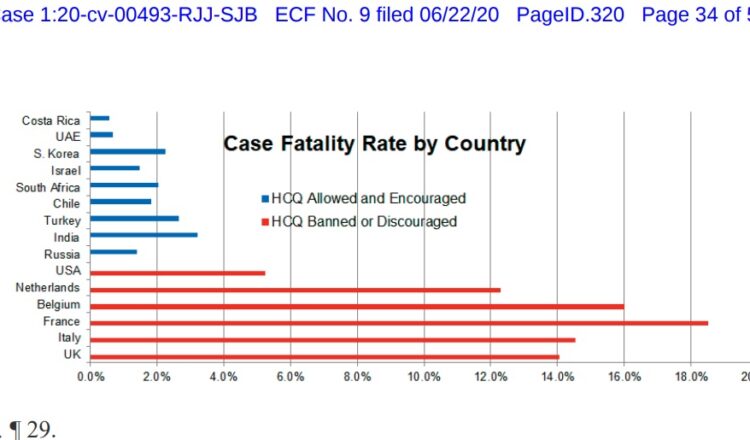
IMHO, this chart tells a big story...Quote:Quote:
Today the Association of American Physicians & Surgeons filed its motion for a preliminary injunction to compel release to the public of hydroxychloroquine by the Food & Drug Administration (FDA) and the Department of Health & Human Services (HHS), in AAPS v. HHS, No. 1:20-cv-00493-RJJ-SJB (W.D. Mich.). Nearly 100 million doses of hydroxychloroquine (HCQ) were donated to these agencies, and yet they have not released virtually any of it to the public.
Quote:
Objective: To describe outcomes of patients with coronavirus disease 2019 (COVID-19) in the outpatient setting after early treatment with zinc, low dose hydroxychloroquine, and azithromycin (the triple therapy) dependent on risk stratification. Design: Retrospective case series study. Setting: General practice.
Participants: 141 COVID-19 patients with laboratory confirmed severe acute respiratory syndrome coronavirus 2 (SARS-CoV-2) infections in the year 2020.
Main Outcome Measures: Risk-stratified treatment decision, rate of hospitalization and all-cause death.
Results: Of 335 positively PCR-tested COVID-19 patients, 127 were treated with the triple therapy. 104 of 127 met the defined risk stratification criteria and were included in the analysis. In addition, 37 treated and eligible patients who were confirmed by IgG tests were included in the treatment group (total N=141). 208 of the 335 patients did not meet the risk stratification criteria and were not treated. After 4 days (median, IQR 3-6, available for N=66/141) of onset of symptoms, 141 patients (median age 58 years, IQR 40-60; 73% male) got a prescription for the triple therapy for 5 days. Independent public reference data from 377 confirmed COVID-19 patients of the same community were used as untreated control. 4 of 141 treated patients (2.8%) were hospitalized, which was significantly less (p<0.001) compared with 58 of 377 untreated patients (15.4%) (odds ratio 0.16, 95% CI 0.06-0.5). Therefore, the odds of hospitalization of treated patients were 84% less than in the untreated group. One patient (0.7%) died in the treatment group versus 13 patients (3.5%) in the untreated group (odds ratio 0.2, 95% CI 0.03-1.5; p=0.16). There were no cardiac side effects.
Conclusions: Risk stratification-based treatment of COVID-19 outpatients as early as possible after symptom onset with the used triple therapy, including the combination of zinc with low dose hydroxychloroquine, was associated with significantly less hospitalizations and 5 times less all-cause deaths.
Quote:
Someone who believes in God and orders his life according to his faith makes a bad start with the secular world. Being a 'simple country doctor' his description is another downer. A 'Board Certified Family Practitioner' is America's closest equivalent to a British GP; Dr Zev has degrees in chemistry as well as medicine, but chose to practise as the family doctor to a close-living orthodox Jewish community in New York state.
When Covid-19 came to America, Dr Zev had a problem. If it took hold, he realised that it would rip through his community like measles through the native Americans. Unlike the NHS, still insisting in defiance of the evidence that 'there is no treatment', Dr Zelenko looked around for what the NHS apparatchiks say doesn't exist, or can only be found in randomised clinical trials taking months to conclude.
He found it from Chinese and Korean reports, and from Professor Didier Raoult in Marseille, with his combination of the old anti-malarial hydroxychloroquine and the equally well-known antibiotic azithromycin, standard for chlamydia, and active also against viruses like Zika and Ebola. He also did some of the reading which the Oxford professors running the RECOVERY clinical trials failed to do.
RECOVERY's information documents parrot this: 'Chloroquine blocks virus infection by increasing endosomal pH required for virus/cell fusion, as well as interfering with the glycosylation of cellular receptors of SARS-CoV.' It's a word-for-word lift from an early February paper in Nature: Cell Research. Very likely these phenomena are indeed part of the anti-viral mechanism of hydroxychloroquine, but they missed completely something else.
By the second week in March, the idea was being openly discussed in a regular series of medical updates on the coronavirus (though unnoticed by the Oxford professors). The March 10 video now shows over a million views.
Zinc was known since 2010 to poison not just coronaviruses, but other RNA viruses too. It's why zinc supplements are sometimes tried to prevent colds. It blocks a critical enzyme called RNA-dependent RNA polymerase, or 'replicase' for short. (Many enzymes are called 'something-ase' where 'something' hints at what it does). This enzyme is fundamental to the virus's ability to copy itself. Poison the replicase: it's 'game over' for the virus. There's one snag: zinc exists in the body as a charged ion, so cannot easily cross cell membranes into the cell where it's needed. But in 2014 it was found that chloroquine functions as a 'zinc ionophore', enabling zinc to cross cell membranes. The cancer researchers who discovered it weren't thinking about viruses at all, but there it was.
Armed with those two simple facts, Dr Zev did the obvious, and added zinc supplements to the 'Marseille cocktail'. Thus the 'Zelenko Protocol' (zinc, hydroxychloroquine and azithromycin) was born.
As Dr Zev now puts it: 'Zinc is the bullet. Hydroxychloroquine is the gun.'
Quote:
President Bolsonaro also said he was taking hydroxychloroquine and Azithromycin to combat the virus.
On Wednesday President Bolsonaro shared some excellent news and took a swipe at his socialist critics by tweeting out that he is doing very well with the hydroxychloroquine treatment.
Picadillo said:
Interview with Dr Drew 2 July 2020
Quote:
Health authorities in Cuba are using low doses of the antimalarial drug hydroxychloroquine to effectively treat COVID-19 patients in the early stages of the disease.
"We do use hydroxychloroquine in the framework of the protocol for management of coronavirus patients," Dr. Augustin Lage Davila, advisor to the president of BioCubaFarma and former director of the Centre for Molecular Immunology in Havana, told Anadolu Agency on Thursday.
Boasting one of the highest ratios in the world in terms of doctor density, at 8.2 per 1,000 people according to the World Bank, Cuba has stood out as one of the most capable countries in the world to fight the deadly coronavirus pandemic with only 86 reported deaths so far and slightly over 2,400 cases.
The US state of Florida alone, which is a stone's throw from the Caribbean nation, has registered over 4,000 deaths and at least 223,000 infections, according to Johns Hopkins University. Overall US infections have surpassed 3.1 million and fatalities have rapidly climbed to over 133,000.
Quote:
Conclusion
Although this is a retrospective analysis, results suggest that early diagnosis, early isolation and early treatment of COVID-19 patients, with at least 3 days of HCQ-AZ lead to a significantly better clinical outcome and a faster viral load reduction than other treatments.
graph at linkQuote:
How do you ethically deny a potential treatment to an eligible patient to conduct a study? So-called double-blind studies described above are the preferred method advocated by Dr. Fauci. These double-blind studies allow people to die in the name of "science" if a drug is effective. They are in the "control group."
There are ethical issues with this approach that researches at the University of Pittsburgh Medical Center addressed with a new concurrent trial based on machine learning developed following the H1N1 pandemic. This method has been ignored by the NIH and FDA approval processes.
Such was the fate of the hydroxychloroquine, azithromycin, and zinc combination. Scientifically there was every reason to believe it would work. Clinically, doctors saw results when directly treating patients. Several recommended that the drug be produced in sufficient amounts and given early and outpatient.
President Trump expressed optimism based on studies in France and China, and the media freaked out. The president's political opposition would go on to cling to any proof the drug would not work and suppress any information that it would. This politicization culminated in the horrific study published by Lancet that the publication quietly retracted.
However, the damage was already done. The World Health Organization suspended trials immediately after the study published in Lancet. Switzerland, which had been using the treatment, prohibited the use of the drug in COVID-19 shortly after that on May 27th. The retraction was so stealth that the ban was not lifted in Switzerland until June 11th.
This window allowed French researchers to analyze what happened in the entire population of COVID-19 patients during the ban. They used the case fatality rate (CFR) as the measure observed. The graph is stunning.
Quote:
The administration has analysed a sample of over 1 lakh [lakh = 100,000] residents, who were mostly close contacts of positive persons and the effect of HCQ in containing the transmission of the virus. According to the analysis, of the 48,873 close contacts of positive patients who took one dose of HCQ, 102 turned Covid-19 positive and 12 succumbed to the infection whereas 48 of the 17,776 close contacts of positive patients who took two doses of HCQ turned positive and only one died. The study also states that of the 33,563 close contacts of patients who took three HCQ doses, 43 tested positive and one died.
____________________________________________________________
"The task force of medical experts, including physicians and super specialists, have recommend and backed the drive to administer HCQ in cluster areas and high exposure cases. We have discussed the analysis and the results with the government. The benefits seem to far outweigh the debate around its risks and it has certainly helped in implementing the preventive strategies planned for the city," Rao said.
Quote:
Here are the highlights of a fascinating report by journalist Claudio Lessa on the effectiveness of hydroxychloroquine treatment for COVID-19. Brazil is using this treatment widely and, as you will hear in the report, it appears to be highly effective. Please be sure to also watch Lessa explain the real reason (besides TDS) why there is so much hostility towards hydroxychloroquine as a treatment.
Quote:
As professor of epidemiology at Yale School of Public Health, I have authored over 300 peer-reviewed publications and currently hold senior positions on the editorial boards of several leading journals. I am usually accustomed to advocating for positions within the mainstream of medicine, so have been flummoxed to find that, in the midst of a crisis, I am fighting for a treatment that the data fully support but which, for reasons having nothing to do with a correct understanding of the science, has been pushed to the sidelines.
As a result, tens of thousands of patients with COVID-19 are dying unnecessarily. Fortunately, the situation can be reversed easily and quickly.
I am referring, of course, to the medication Hydroxychloroquine. When this inexpensive oral medication is given very early in the course of illness, before the virus has had time to multiply beyond control, it has shown to be highly effective, especially when given in combination with the antibiotics azithromycin or doxycycline and the nutritional supplement zinc.
On May 27, I published an article in the American Journal of Epidemiology (AJE) entitled, "Early Outpatient Treatment of Symptomatic, High-Risk COVID-19 Patients that Should be Ramped-Up Immediately as Key to the Pandemic Crisis." That article, published in the world's leading epidemiology journal, analyzed five studies, demonstrating clear-cut and significant benefits to treated patients, plus other very large studies that showed the medication safety.
Physicians who have been using these medications in the face of widespread skepticism have been truly heroic. They have done what the science shows is best for their patients, often at great personal risk. I myself know of two doctors who have saved the lives of hundreds of patients with these medications, but are now fighting state medical boards to save their licenses and reputations.
Quote:
Dr. Harvey Risch, an epidemiology professor at Yale School of Public Health, said on Tuesday that he thinks hydroxychloroquine could save 75,000 to 100,000 lives if the drug is widely used to treat coronavirus.
"There are many doctors that I've gotten hostile remarks about saying that all the evidence is bad for it and, in fact, that is not true at all," Risch told "Ingraham Angle," adding that he believes the drug can be used as a "prophylactic" for front-line workers, as other countries like India have done.
Risch lamented that a "propaganda war" is being waged against the use of the drug for political purposes, not based on "medical facts."
Quote:
Coordinator of the Integrated Toxicological Surveillance Center (Civitox), the toxicologist and nutritionist Sandro Benites is an advocate for the use of the Covid Kit, which includes drugs such as Hydroxychloroquine, Azithromycin, Ivermectin, Zinc and Vitamin D for early treatment of Covid-19.
In Campo Grande he led a group of 300 doctors who convinced Mayor Marquinhos Trad to adopt the service protocol that includes the distribution of the kit, with medical prescription in specific cases. The same protocol was adopted in 12 other Brazilian capitals and is being studied in the others. It was developed based on experiences that worked in countries like Spain and the United States, even before the pandemic reached Brazil, according to the doctor.
In an interview with O PROGRESSO, he was categorical in stating that these drugs are effective in early treatment and do not bring health data, as long as used following medical guidelines.
Quote:
Results: The addition of zinc sulfate did not impact the length of hospitalization, duration of ventilation, or ICU duration. In univariate analyses, zinc sulfate increased the frequency of patients being discharged home, and decreased the need for ventilation, admission to the ICU, and mortality or transfer to hospice for patients who were never admitted to the ICU. After adjusting for the time at which zinc sulfate was added to our protocol, an increased frequency of being discharged home (OR 1.53, 95% CI 1.12-2.09) reduction in mortality or transfer to hospice remained significant (OR 0.449, 95% CI 0.271-0.744).
Conclusion: This study provides the first in vivo evidence that zinc sulfate in combination with hydroxychloroquine may play a role in therapeutic management for COVID-19.