
That's right. I know that his USMC records were released with the Warren Commission report. I don't know if they were publicly released prior to that. But his records in the Marines were discussed in the Warren commission. He had a negligent discharge where he shot himself in the elbow at one point. He was also court martialed for hitting/fighting with his sergeant. Did not have the best record overall.neAGle96 said:
Edit.
I see the sharpshooter designation assigned to him in 1956 and then marksman assigned in 59 when he scored lower.
When were his marine corps records released?
JFK, MLK, RFK files declassified.
129,026 Views |
1060 Replies |
Last: 5 mo ago by rgvag11

to counterbalance my CIA friend who said LBJ did it, I had an FBI agent bud who said the three shots weren't that difficult and he had friends that had duplicated them in the same time span.
The House Select Committee of Assassinations found that there was a high probability of a second shooter based solely on the Dictabelt recording from a police officer that keyed open his mic on a motorcycle. That was the only evidence that they found that suggested a second shooter and based on that evidence, there had to be a conspiracy. Because the liklihood of two shooters being there by coincidence is extraordinarily low, which I agree with.neAGle96 said:
What's your opinion on the house select committees 1979 ruling there was a high probability there were 2 shooters?
Why discount this?
The problem is that the dictabelt has since been disproven.
After this, Harvard and the National Academy of Science examined it and proved the Dictabelt conclusions were wrong.
You can read the findings here:
http://www.nap.edu/catalog/10264.html
More analysis: https://rlg.fas.org/RL9b02_WithFigNums&Preamble_RL6818_JFKReply(+FullPageFigures).pdfQuote:
The acoustic analyses do not demonstrate that there was a grassy knoll shot, and in particular there is no acoustic basis for the claim of 95% probability of such a shot.
The acoustic impulses attributed to gunshots were recorded about one minute after the President had been shot and the motorcade had been instructed to go to the hospital.
Therefore, reliable acoustic data do not support a conclusion that there was a second gunman."
If the Dictabelt is wrong, then the conclusion is wrong, because the HSCA's entire conclusion was predicated on the Dictabelt.
I've been to the school book depository museum.
A trained marksman could make the shot. Could they do 3 or potentially four shots w a bolt action in the time frame? (4.8 to 8 seconds, in the allotted time, I don't know.. I've seen varied claims from sound of the 1st to the head wound),
Same Marne corps buddy was classified as an "expert" marksman and spent his last 2 years in the corps as the rifle range instructor at Camp Pendleton.
He went to the school book depository museum w me and said absolutely not could he get 4 shots off w a bolt action in under 10 seconds and stated unlikely could he get 3 off w a bolt action w any degree of accuracy on the 3rd shot
I think undoubtedly LHO was involved. I'm unsure if there was anyone else.
I don't know if I'd give more credence to the Warren commission report then I do w the 1979 congressional house select committee report. Just by the composition of the two committees I would be more inclined to think the Warren commission would be more likely to mislead
** I was going to post pictures from the snipers nest but you need a membership to do so
A trained marksman could make the shot. Could they do 3 or potentially four shots w a bolt action in the time frame? (4.8 to 8 seconds, in the allotted time, I don't know.. I've seen varied claims from sound of the 1st to the head wound),
Same Marne corps buddy was classified as an "expert" marksman and spent his last 2 years in the corps as the rifle range instructor at Camp Pendleton.
He went to the school book depository museum w me and said absolutely not could he get 4 shots off w a bolt action in under 10 seconds and stated unlikely could he get 3 off w a bolt action w any degree of accuracy on the 3rd shot
I think undoubtedly LHO was involved. I'm unsure if there was anyone else.
I don't know if I'd give more credence to the Warren commission report then I do w the 1979 congressional house select committee report. Just by the composition of the two committees I would be more inclined to think the Warren commission would be more likely to mislead
** I was going to post pictures from the snipers nest but you need a membership to do so
The only thing new of substance the HSCA had was the dictabelt, which has been repeatedly disproven since. The fact that they were created to prove a conspiracy and was completely unable to prove a conspiracy lends more evidence of a lone assassin.neAGle96 said:
I've been to the school book depository museum.
A trained marksman could make the shot. Could they do 3 or potentially four shots w w bolt action in the time frame? (4.8 to 8 seconds, in the allotted time, I dint know.. I've seen varied claims from sound of the to the head wound),
Ale Marne corps buddy was classified as an "expert" marksman and spent his last 2 years in the corps as the rifle range instructor at Camp Pendleton.
He went to the school book depository museum w me and said absolutely not could he get 4 shots off w a bolt action in under 10 seconds and stated unlikely could he get 3 off w a bolt action any degree of accuracy.
I think undoubtedly LHO was involved. I'm unsure if there was anyone else.
My 2 pesos, I think I have more reservations w the Warren commission report then I do w the 1979 congressional house select committee report
He got off 3 shots. They initially believed it was in the 4-6 second range. Most modern analysis believe it is closer to 8-13 seconds for the three shots, depending on when the first shot was taken (some say it was before Zapruder started.)
Remember that the gun is ready to go for the first one. Clock starts counting when the trigger is pulled the first time. If you believe the low end of 8 seconds, that means for shot 2 and shot 3, you have about 4 seconds to cycle the action, aim, and fire each time. If you believe on the high end, is it six seconds each time.
Either way, four seconds to cycle the action, aim, and fire with a 4x scope at a distance of 50 to 81 meters is not that difficult. And remember that the USMC experts said that because of the angle from the 6th floor and the downhill slope, the target would have been almost stationary, making the shot easier.
Having 3, 4, 5, or even 6 seconds between shots is plenty of time. Also, when people are recreating it, they are racing a clock. LHO wouldn't have had to worry if he got the 3rd shot off in a certain amount of time, only had to worry about getting shots on target.
This channel has an old Discovery Channel video "Inside the Target Car" which shows a modern recreation shooting from a scissor lift into ballistics gel. https://www.youtube.com/@JFKBallistics/videos
This video is good and goes over the shots and also the dictabelt we talked about earlier. They are able to recreate perfectly the 2nd shot that hit Kennedy and Connally with matching wounds.
As far as photos from the sniper's nest, to recreate the visual of a typical person, you would need to use a lens that is about a 50mm focal length. To recreate the 4x scope, you would need to use a 200mm camera lens. Most photos from up there use wide angle lenses to get the window in the frame as well.
----------------
I have a tough time believing that any trained marksman doesn't think they can hit a target two out of three times at 180 to 265 feet with a 4x scope given 4 seconds to cycle the action and fire each time.
I've never seen any conclusive evidence/ proof that Oswald ever fired the rifle that day. I believe he "passed" paraffin tests which would seem exculpatory. He was an average marksman at best, as a Marine. He (or many people) could have made AN accurate shot from the TSBD perch, but the question unanswered is could someone make three in the time allotted, with the needed degree of accuracy.
That still doesn't account for Arlen Specter's ludicrous "single bullet theory".
Nor does it explain the "kill shot" revealed in the unedited Zapruder film showing JFK's head exploding and moving backwards, with the spray of blood and brain matter exiting to the rear, which ended up getting all over the motorcycle cops escorting the limousine's left rear flank. Not to mention that troublesome piece of skull Jackie retrieved immediately from the limo trunk lid. How do people simply gloss over these indisputable pieces of evidence observed by the entire world?
I've no doubt LHO was involved in some capacity. His rifle convicts him of that. But I remain unconvinced he was even on the sixth floor at the time. I'm certain he was framed for Officer Tippet's murder. Yet another red flag, and further evidence of a conspiracy.
That still doesn't account for Arlen Specter's ludicrous "single bullet theory".
Nor does it explain the "kill shot" revealed in the unedited Zapruder film showing JFK's head exploding and moving backwards, with the spray of blood and brain matter exiting to the rear, which ended up getting all over the motorcycle cops escorting the limousine's left rear flank. Not to mention that troublesome piece of skull Jackie retrieved immediately from the limo trunk lid. How do people simply gloss over these indisputable pieces of evidence observed by the entire world?
I've no doubt LHO was involved in some capacity. His rifle convicts him of that. But I remain unconvinced he was even on the sixth floor at the time. I'm certain he was framed for Officer Tippet's murder. Yet another red flag, and further evidence of a conspiracy.
This is not true. Dallas PD Chief Jesse Curry said in an interview that Oswald's hand tested positive on the paraffin test.BoerneGator said:
I've never seen any conclusive evidence/ proof that Oswald ever fired the rifle that day. I believe he "passed" paraffin tests which would seem exculpatory.
"Chief, we understand you've had the results of the paraffin tests which were made to determine whether Oswald had fired a weapon. Can you tell us what those tests showed?" "I understand that it was positive," Curry tells them. "But, what does that mean?" "It only means that he fired a gun," Curry says.
This was broadcast on KRLD-TV on Nov 23rd and the video is shown in the 6th Floor Museum.
Both hands had GSR on it from the paraffin test. His face did not. FWIW: Paraffin tests are not considered very accurate.
Because the paraffin tests could not differentiate between firing the rifle and firing the revolver and the FBI said paraffin tests were not reliable, the Warren Commission ignored the paraffin tests entirely.
Quote:
He was an average marksman at best, as a Marine. He (or many people) could have made AN accurate shot from the TSBD perch, but the question unanswered is could someone make three in the time allotted, with the needed degree of accuracy.
The actual Marines in charge of marksmanship said it would be an easy shot for someone with Oswald's training and ability.

Quote:
That still doesn't account for Arlen Specter's ludicrous "single bullet theory".
Which has been recreated multiple times in the last 60 years.
Indeed.Quote:
Nor does it explain the "kill shot" revealed in the unedited Zapruder film showing JFK's head exploding and moving backwards, with the spray of blood and brain matter exiting to the rear, which ended up getting all over the motorcycle cops escorting the limousine's left rear flank. Not to mention that troublesome piece of skull Jackie retrieved immediately from the limo trunk lid. How do people simply gloss over these indisputable pieces of evidence observed by the entire world?
Quote:
I've no doubt LHO was involved in some capacity. His rifle convicts him of that. But I remain unconvinced he was even on the sixth floor at the time. I'm certain he was framed for Officer Tippet's murder. Yet another red flag, and further evidence of a conspiracy.
Based on what evidence?
Didn't the House Committee agree with the single bullet theory?
I'm Gipper
I'm Gipper
I'm curious how far people think that is. Some of the "experts" I've seen on TV shows make it sound like he would've been aiming at a dot. Internet results say 265 feet. A good kicker could have dropped a football into JFK's lap from that distance.Quote:
The farthest shot was less than 100 yards and he had a 4x scope.
I have pretty clear pictures of deer taken with my crappy old iphone at close to 500 feet, with no scope.
Jugstore Cowboy said:I'm curious how far people think that is. Some of the "experts" I've seen on TV shows make it sound like he would've been aiming at a dot. Internet results say 265 feet. A good kicker could have dropped a football into JFK's lap from that distance.Quote:
The farthest shot was less than 100 yards and he had a 4x scope.
I have pretty clear pictures of deer taken with my crappy old iphone at close to 500 feet, with no scope.

You can use Google Maps to measure it. https://maps.app.goo.gl/oJgLhSo41YsuXdvj7
That shot with a 4x scope is not hard. It certainly is not far.
They believed that three shots were fired from the window by Oswald's rifle to the exclusion of all other rifles and that included the single bullet. They believed there was also a 4th shot that was only heard on the dictabelt.Im Gipper said:
Didn't the House Committee agree with the single bullet theory?
So they concluded that the single bullet did all the damage that the Warren
report said?
I'm Gipper
report said?
I'm Gipper
https://www.archives.gov/research/jfk/select-committee-report/part-1a.htmlIm Gipper said:
So they concluded that the single bullet did all the damage that the Warren
report said?
Yes. They also brought in experts to examine the autopsy photos and X-rays and to authenticate them.
The House Select Committee on Assassinations was pretty clear in their findings.Quote:
The committee's forensic pathology panel was composed of nine members, eight of whom were chief medical examiners in major local jurisdictions in the United States.(11) As a group, they had been responsible for more than 100,000 autopsies, (12) an accumulation of experience the committee deemed invaluable in the evaluation of the medical evidence--including the autopsy X-rays and photographs--to determine the cause of death of the President and the nature and location of his wounds.
The forensic pathology panel concluded that President Kennedy was struck by two, and only two, bullets, each of which entered from the rear. The panel further concluded that the President was struck by one bullet that entered in the upper right of the back and exited from the front of the throat, and one bullet that entered in the right rear of the head near the cowlick area and exited from the right side of the head, toward the front. This second bullet caused a massive wound to the President's head upon exit. There is no medical evidence that the President was struck by a bullet entering the front of the head,(19) and the possibility that a bullet could have struck the President and yet left no evidence is extremely remote. Because this conclusion appears to be inconsistent with the backward motion of the President's head in the Zapruder film, the committee consulted a wound ballistics expert to determine what relationship, if any, exists between the direction from which a bullet strikes the head and subsequent head movement. (20) The expert concluded that nerve damage from a bullet entering the President's head could have caused his back muscles to tighten which, in turn, could have caused his head to move toward the rear.(21) He demonstrated the phenomenon in a filmed experiment which involved the shooting of goats. (22) Thus, the committee determined that the rearward movement of the President's head would not be fundamentally inconsistent with a bullet striking from the rear.(23)
They went on to confirm the single bullet:
Quote:
The forensic pathology panel determined that Governor Connally was struck by a bullet from the rear, one that entered just below the right armpit and exited below the right nipple of the chest. It then shattered the radius bone of the Governor's right wrist and caused a superficial wound to the left thigh. (24) Based on its examination of the nature and alinement of the Governor's wounds, the panel concluded that they were all caused by a single bullet that came from the rear. It concluded further that, having caused the Governor's wounds, the bullet was dislodged from his left thigh.
The panel determined that the nature of the wounds of President Kennedy and Governor Connally was consistent with the possibility that one bullet entered the upper right back of President Kennedy and, after emerging from the front of the neck, caused all of the Governor's wounds. (25) A factor that influenced the panel significantly was the ovoid shape of the wound in the Governor's back, indicating that the bullet had begun to tumble or yaw before entering.(26) An ovoid wound is characteristic of one caused by a bullet that has passed through or glanced off an intervening object. (27) Based on the evidence available to it, the panel concluded that a single bullet passing through both President Kennedy and Governor Connally would support a fundamental conclusion that the President was struck by two, and only two, bullets, each fired from behind. (28) Thus, the forensic pathology panel's conclusions were consistent with the so-called single bullet theory advanced by the Warren Commission. (29)
I used google earthview to measure the distance from where I was taking the pictures, and where the tree line is. It was eye-opening, so to speak, to put a number on what's clear to the naked eye and what's clear with a little magnification.Quote:
You can use Google Maps to measure it
But anyone who played a little football, or watched enough, knows what an adult male looks like at 100 yards. It's not a great distance.
Exactly. This is an easy shot with iron sights. He had a 4x scope.Jugstore Cowboy said:I used google earthview to measure the distance from where I was taking the pictures, and where the tree line is. It was eye-opening, so to speak, to put a number on what's clear to the naked eye and what's clear with a little magnification.Quote:
You can use Google Maps to measure it
But anyone who played a little football, or watched enough, knows what an adult male looks like at 100 yards. It's not a great distance.
When was the last time your buddy came back from the gun range bragging about hitting 2 of 3 targets from 50-80 yards with a 4x scope?
Moving targets?

At a distance where the shape and size are easy to make out?nortex97 said:
Moving targets?
This is a skittish young deer turning to bolt at a little over 300 feet (according to google maps measurement):
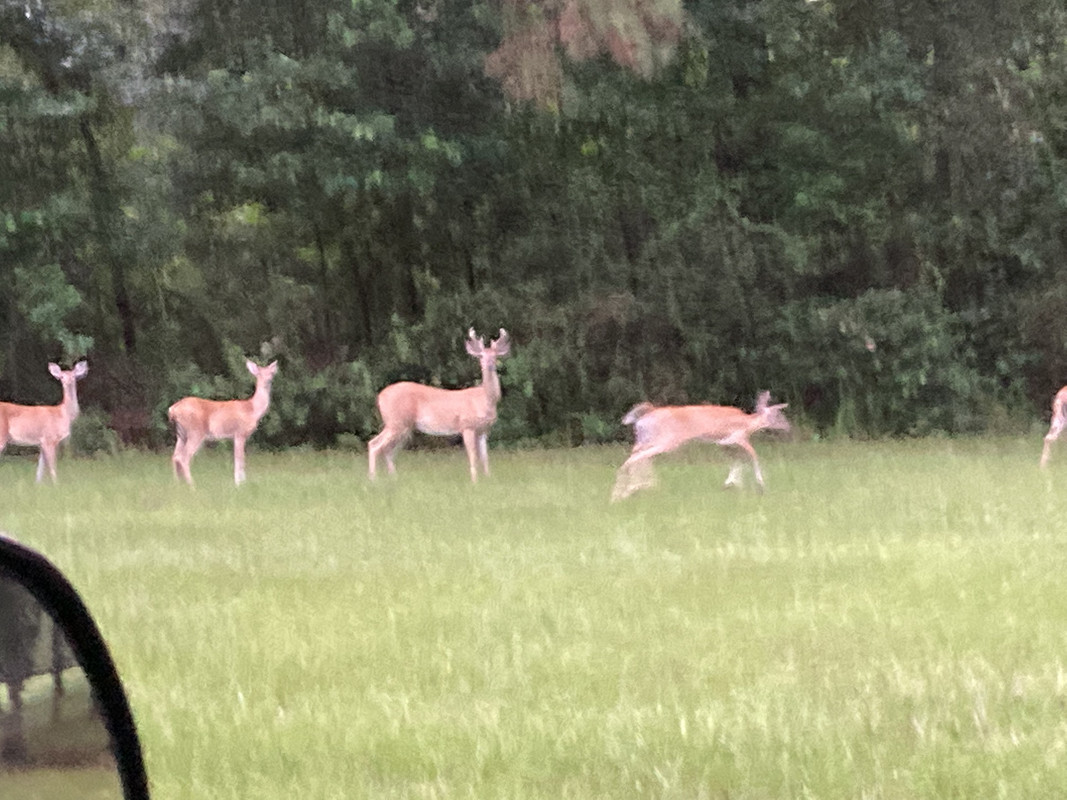
Magnified thru the camera of an old, slow clicking iphone.
*corrected yards to feet, slight difference

Someone current day should build a setup like the shooting event at a range somewhere, Moving target, shooting just like it they Book Depository. Wonder how many people would go to it to just see if they could have done what was said to have occured. I know it sounds morbid but so many people say it would have been easy to do.
There's a lot of conflicting info on the internet. One can find whatever he needs to confirm a biasQuote:
There were no nitrates on Oswald's cheek, indicating he hadn't fired a rifle. There were nitrates on his hands, but on the palms, not the back of his hand. When you fire a pistol it deposits nitrates on the back of the hand holding the pistol. In 1963 handling cardboard boxes or a newspaper could cause you to test positive for nitrates. Oswald handled boxes in his job and read newspapers all the time, including on the morning of the 22nd of November, 1963. So, Oswald had no nitrates on his cheek and the back of his hand, indicating he did not fire a rifle or pistol. Because of his job, the nitrates on the palm of his hand is meaningless.
To be fair, the FBI did tests with firing a rifle and some of the shooters tested negative. Overall, the the FBI and the WC decided that the "Paraffin tests were unreliable.
Even this own statement conflicts with itself. And the FBI experiments you cited are correct: many people that fired a rifle in tests did not test positive on their cheek, which would discount the very first statement of your post that a negative test on the cheek would indicate that he had not fired a rifle.BoerneGator said:There's a lot of conflicting info on the internet. One can find whatever he needs to confirm a biasQuote:
There were no nitrates on Oswald's cheek, indicating he hadn't fired a rifle. There were nitrates on his hands, but on the palms, not the back of his hand. When you fire a pistol it deposits nitrates on the back of the hand holding the pistol. In 1963 handling cardboard boxes or a newspaper could cause you to test positive for nitrates. Oswald handled boxes in his job and read newspapers all the time, including on the morning of the 22nd of November, 1963. So, Oswald had no nitrates on his cheek and the back of his hand, indicating he did not fire a rifle or pistol. Because of his job, the nitrates on the palm of his hand is meaningless.
To be fair, the FBI did tests with firing a rifle and some of the shooters tested negative. Overall, the the FBI and the WC decided that the "Paraffin tests were unreliable.
His hands tested positive.
Because of reliability testing, the Warren Commission ignored the tests, even the inculpatory tests.
They are no longer done and not considered reliable. They were not considered reliable at the time.
I am not sure why you even brought them up, other than a mistaken belief that they were negative.
AlaskanAg99 said:
The big one is Epstine.
Everything else is so long ago I don't think many will care. Even those responsible are all long dead.
Then telivise RFK Jr.taking a whizz on their graves!

Here's where I am on the shooter:
Oswald had a 4x18 scope on the 6.5mm Carcano Model 91/38 rifle; it was an Ordnance Optics scope, 3/4-inch tube, an 18mm objective lens, a simple crosshair reticle, and basic windage/elevation adjustments. It was a low-quality, imported scope, side-mounted on the rifle, with poor optical clarity and a misalignment that required shims to correct during FBI testing. Its field of view was approx 20 feet at 100 yards.
A few points in no particular order:
My bonafides: I shoot a fair amount. I qual'd as Marine Expert as a young man....no special marksmanship training beyond that from the military perspective. I never used a scope until about 10 years ago. So everything I shot up until then was with iron sights. In the last 10 years I have spent a lot of time shooting with scopes. I shoot a lot to be proficient for the type of hunting I do. I don't really view myself as a great shooter; though I have made my share of great shots. I have trained with elite shooters...they are spooky good. I am confident in saying I am well above average and well trained; but I would not say "elite".
I practice on ranges with varying scopes and some specific exercises; shooting; cycling the bolt, re-acquiring another target; and placing an accurate round on that target; with someone with a stop watch on me. The goal; shoot and reacquire and accurately shoot in less than 10 seconds. The "moved target" being anywhere from 25yds to 500 yds away. This simulates shooting an animal; not knocking it down with the first shot; and having to shoot the wounded animal as it has moved away. So, basically, what the lone gunman shooter would have had to do.
I score very well on getting an accurate round on the followup shot within 10 seconds; by accurate I mean on anything from a 6" to 12" plate depending on distance to target. ..usually 8". 80% of the time...some days (especially with little wind) better. But consistently 8 of 10 within 10 seconds across a wide range of distances. Many times in under 5 seconds...but often clicking the round when the counter says 9....mostly now I use a Z8i 2.3-18x56 scope...so great field of view on picking up the second target (about 20m field of view). I don't have to worry about my scope retaining zero even with heavy abuse. I don't have to do anything special holding a different distance or for wind; my BRH reticle makes that doable.
As a Marine, Oswald struggled to maintain "Marksman" status...his skills degraded during his tenure according to records; he qualified with the M1 Garand. He scored 191 at the range in 1959; anything below 190 is failing. Friends/acquaintances told the Commission he was a poor shot...now, the magic shot was from about 88yds...so a far cry from trying to qualify from 200, 300 and out to 500 yds. But, he was nothing special in the Marines....below average. But, I feel as far as against the general population of shooters, though, he was probably at least an average shot.
Given all of the above; I find it unlikely Oswald fired 3 shots; accurately; cycled the bolt twice (2.3 seconds required each time according to the FBI), reacquired a moving target twice, looking thru a "tunnel" (the 18mm FOV scope) under pressure. I believe it much more likely he didn't use the scope at all; and fired using the iron sights. He was used to iron sights; had trained with them. It would be much easier to reacquire a target using iron sights:
Scope Issues Outweigh Benefits: The scope's misalignment, poor quality, and side-mount configuration likely made it a liability rather than an asset. At 60-88 yards, 4x magnification offers minimal advantage over iron sights, and the narrow FOV and awkward positioning could have slowed Oswald downcrucial in a short shooting window. FBI tests showed the rifle was accurate with iron sights at similar ranges. Oswald's Comfort Zone: His Marine training with iron sights at longer ranges (200-500 yards) suggests he could handle 88 yards effortlessly with the Carcano's sights. His lack of scope experience reinforces this preference, as adapting to a new system under pressure seems unlikely for a marginal shooter (191 in 1959). Practicality in the Moment: For three shots, including a miss and two hits, iron sights line up with the need for speed and simplicity. The headshot's precision could result from a steady aim over familiar sights, not a misaligned scope requiring guesswork.
Absent this explanation; I don't think there is any way Oswald fired 3 shots (2 accurately) in that timeframe, while cycling the bolt, using that scope to re-acquire the target each time.
Oswald had a 4x18 scope on the 6.5mm Carcano Model 91/38 rifle; it was an Ordnance Optics scope, 3/4-inch tube, an 18mm objective lens, a simple crosshair reticle, and basic windage/elevation adjustments. It was a low-quality, imported scope, side-mounted on the rifle, with poor optical clarity and a misalignment that required shims to correct during FBI testing. Its field of view was approx 20 feet at 100 yards.
A few points in no particular order:
- That's a pretty narrow field of view. Most "more modern" scopes with 30+mm objective lenses will provide 3x+ field of view at 4x magnification.
- The scope was side mounted and "shimmed" in place
- When tested by the FBI; the rifle was not zeroed
- Both Zeroing and aiming a side mounted rifle presents challenges
- The iron sights were still on the rifle
- The best data I can find on the timing from 1st shot to final shot was "likely 5.6 seconds (accepted by the Warren Commission)"; but could be as long as 8 seconds based on some views.
My bonafides: I shoot a fair amount. I qual'd as Marine Expert as a young man....no special marksmanship training beyond that from the military perspective. I never used a scope until about 10 years ago. So everything I shot up until then was with iron sights. In the last 10 years I have spent a lot of time shooting with scopes. I shoot a lot to be proficient for the type of hunting I do. I don't really view myself as a great shooter; though I have made my share of great shots. I have trained with elite shooters...they are spooky good. I am confident in saying I am well above average and well trained; but I would not say "elite".
I practice on ranges with varying scopes and some specific exercises; shooting; cycling the bolt, re-acquiring another target; and placing an accurate round on that target; with someone with a stop watch on me. The goal; shoot and reacquire and accurately shoot in less than 10 seconds. The "moved target" being anywhere from 25yds to 500 yds away. This simulates shooting an animal; not knocking it down with the first shot; and having to shoot the wounded animal as it has moved away. So, basically, what the lone gunman shooter would have had to do.
I score very well on getting an accurate round on the followup shot within 10 seconds; by accurate I mean on anything from a 6" to 12" plate depending on distance to target. ..usually 8". 80% of the time...some days (especially with little wind) better. But consistently 8 of 10 within 10 seconds across a wide range of distances. Many times in under 5 seconds...but often clicking the round when the counter says 9....mostly now I use a Z8i 2.3-18x56 scope...so great field of view on picking up the second target (about 20m field of view). I don't have to worry about my scope retaining zero even with heavy abuse. I don't have to do anything special holding a different distance or for wind; my BRH reticle makes that doable.
As a Marine, Oswald struggled to maintain "Marksman" status...his skills degraded during his tenure according to records; he qualified with the M1 Garand. He scored 191 at the range in 1959; anything below 190 is failing. Friends/acquaintances told the Commission he was a poor shot...now, the magic shot was from about 88yds...so a far cry from trying to qualify from 200, 300 and out to 500 yds. But, he was nothing special in the Marines....below average. But, I feel as far as against the general population of shooters, though, he was probably at least an average shot.
Given all of the above; I find it unlikely Oswald fired 3 shots; accurately; cycled the bolt twice (2.3 seconds required each time according to the FBI), reacquired a moving target twice, looking thru a "tunnel" (the 18mm FOV scope) under pressure. I believe it much more likely he didn't use the scope at all; and fired using the iron sights. He was used to iron sights; had trained with them. It would be much easier to reacquire a target using iron sights:
Absent this explanation; I don't think there is any way Oswald fired 3 shots (2 accurately) in that timeframe, while cycling the bolt, using that scope to re-acquire the target each time.

If ultra HD photos surfaced that proved JFK was shot in the face, the new narrative would just become "Oswald had an accomplice".
We have already proven with hard evidence the feds planned and executed a coup via Crossfire Hurricane. In the same way most of society rejects that treasonous reality, most of society would reject any new evidence implicating the CIA/LBJ in JFK killing.
BTW, no one has refuted that right handed Gary Underhill likely didn't shoot himself behind the left ear, as has been reported. Surly there is an autopsy report or record of Underhills dominant hand to prove or disprove. Simply writing it off as "Russia Disninfo" with no evidence is careless and irresponsible.
We have already proven with hard evidence the feds planned and executed a coup via Crossfire Hurricane. In the same way most of society rejects that treasonous reality, most of society would reject any new evidence implicating the CIA/LBJ in JFK killing.
BTW, no one has refuted that right handed Gary Underhill likely didn't shoot himself behind the left ear, as has been reported. Surly there is an autopsy report or record of Underhills dominant hand to prove or disprove. Simply writing it off as "Russia Disninfo" with no evidence is careless and irresponsible.
Raptor

Joined:
Feb 23, 2001
Posts:
26,109
How long do you want to ignore this user?
Thanks for your post Marine, and Semper Fi. Not sure I knew that about you, but pleased to know it.
Something tells me you'll not be challenged on anything you've posted, but hope I'm proven wrong, because I'd love to witness the exchange…
You enjoy the honor of being the OP of one of the all-time epic threads on TexAgs. Hope to see your collection some day!
Something tells me you'll not be challenged on anything you've posted, but hope I'm proven wrong, because I'd love to witness the exchange…
You enjoy the honor of being the OP of one of the all-time epic threads on TexAgs. Hope to see your collection some day!
Guitarsoup said:https://www.archives.gov/research/jfk/select-committee-report/part-1a.htmlIm Gipper said:
So they concluded that the single bullet did all the damage that the Warren
report said?
Yes. They also brought in experts to examine the autopsy photos and X-rays and to authenticate them.The House Select Committee on Assassinations was pretty clear in their findings.Quote:
The committee's forensic pathology panel was composed of nine members, eight of whom were chief medical examiners in major local jurisdictions in the United States.(11) As a group, they had been responsible for more than 100,000 autopsies, (12) an accumulation of experience the committee deemed invaluable in the evaluation of the medical evidence--including the autopsy X-rays and photographs--to determine the cause of death of the President and the nature and location of his wounds.
The forensic pathology panel concluded that President Kennedy was struck by two, and only two, bullets, each of which entered from the rear. The panel further concluded that the President was struck by one bullet that entered in the upper right of the back and exited from the front of the throat, and one bullet that entered in the right rear of the head near the cowlick area and exited from the right side of the head, toward the front. This second bullet caused a massive wound to the President's head upon exit. There is no medical evidence that the President was struck by a bullet entering the front of the head,(19) and the possibility that a bullet could have struck the President and yet left no evidence is extremely remote. Because this conclusion appears to be inconsistent with the backward motion of the President's head in the Zapruder film, the committee consulted a wound ballistics expert to determine what relationship, if any, exists between the direction from which a bullet strikes the head and subsequent head movement. (20) The expert concluded that nerve damage from a bullet entering the President's head could have caused his back muscles to tighten which, in turn, could have caused his head to move toward the rear.(21) He demonstrated the phenomenon in a filmed experiment which involved the shooting of goats. (22) Thus, the committee determined that the rearward movement of the President's head would not be fundamentally inconsistent with a bullet striking from the rear.(23)
They went on to confirm the single bullet:Quote:
The forensic pathology panel determined that Governor Connally was struck by a bullet from the rear, one that entered just below the right armpit and exited below the right nipple of the chest. It then shattered the radius bone of the Governor's right wrist and caused a superficial wound to the left thigh. (24) Based on its examination of the nature and alinement of the Governor's wounds, the panel concluded that they were all caused by a single bullet that came from the rear. It concluded further that, having caused the Governor's wounds, the bullet was dislodged from his left thigh.
The panel determined that the nature of the wounds of President Kennedy and Governor Connally was consistent with the possibility that one bullet entered the upper right back of President Kennedy and, after emerging from the front of the neck, caused all of the Governor's wounds. (25) A factor that influenced the panel significantly was the ovoid shape of the wound in the Governor's back, indicating that the bullet had begun to tumble or yaw before entering.(26) An ovoid wound is characteristic of one caused by a bullet that has passed through or glanced off an intervening object. (27) Based on the evidence available to it, the panel concluded that a single bullet passing through both President Kennedy and Governor Connally would support a fundamental conclusion that the President was struck by two, and only two, bullets, each fired from behind. (28) Thus, the forensic pathology panel's conclusions were consistent with the so-called single bullet theory advanced by the Warren Commission. (29)
You can find an expert to counter any expert or argument. It doesn't mean they are right. Ballistic exit holes are larger than entrance holes. I will never believe that a shot that blew off a rear part of JFK's skull, which landed on the trunk of the limousine and that Jackie climbed back to retrieve, came from the rear. I also don't buy the "magic bullet" theory.
Something non-scientific that I have always found curious, as someone who has stood at "the window" back when you could do that, is why Oswald didn't take the shot during the hairpin turn onto Elm? Why wait until JFK is moving down and away, still with little relative motion but with increasing range? The question screams in your mind as you look out that window. The relative motion in the hairpin turn is zero and the distance is point blank. The only conclusions I could draw were either Oswald wasn't ready (unlikely) or the hairpin turn does not provide the crossing fields of fire that Dealey Plaza does and that Oswald was not a lone gunman.
I believe that's already been addressed much earlier in this thread.
The conclusions I posted are from the House Select Committee on Assassinations, and this committed was created explicitly to find a conspiracy. Their conclusion was there was a conspiracy (based on since debunked dictabelt evidence discussed here previously). These are the conclusions of experts used and brought in to prove conspiracy. If you have experts that have thoroughly examined the evidence, and come to a different conclusion, I would love to read their methodology, reasoning, and conclusions.stetson said:Guitarsoup said:https://www.archives.gov/research/jfk/select-committee-report/part-1a.htmlIm Gipper said:
So they concluded that the single bullet did all the damage that the Warren
report said?
Yes. They also brought in experts to examine the autopsy photos and X-rays and to authenticate them.The House Select Committee on Assassinations was pretty clear in their findings.Quote:
The committee's forensic pathology panel was composed of nine members, eight of whom were chief medical examiners in major local jurisdictions in the United States.(11) As a group, they had been responsible for more than 100,000 autopsies, (12) an accumulation of experience the committee deemed invaluable in the evaluation of the medical evidence--including the autopsy X-rays and photographs--to determine the cause of death of the President and the nature and location of his wounds.
The forensic pathology panel concluded that President Kennedy was struck by two, and only two, bullets, each of which entered from the rear. The panel further concluded that the President was struck by one bullet that entered in the upper right of the back and exited from the front of the throat, and one bullet that entered in the right rear of the head near the cowlick area and exited from the right side of the head, toward the front. This second bullet caused a massive wound to the President's head upon exit. There is no medical evidence that the President was struck by a bullet entering the front of the head,(19) and the possibility that a bullet could have struck the President and yet left no evidence is extremely remote. Because this conclusion appears to be inconsistent with the backward motion of the President's head in the Zapruder film, the committee consulted a wound ballistics expert to determine what relationship, if any, exists between the direction from which a bullet strikes the head and subsequent head movement. (20) The expert concluded that nerve damage from a bullet entering the President's head could have caused his back muscles to tighten which, in turn, could have caused his head to move toward the rear.(21) He demonstrated the phenomenon in a filmed experiment which involved the shooting of goats. (22) Thus, the committee determined that the rearward movement of the President's head would not be fundamentally inconsistent with a bullet striking from the rear.(23)
They went on to confirm the single bullet:Quote:
The forensic pathology panel determined that Governor Connally was struck by a bullet from the rear, one that entered just below the right armpit and exited below the right nipple of the chest. It then shattered the radius bone of the Governor's right wrist and caused a superficial wound to the left thigh. (24) Based on its examination of the nature and alinement of the Governor's wounds, the panel concluded that they were all caused by a single bullet that came from the rear. It concluded further that, having caused the Governor's wounds, the bullet was dislodged from his left thigh.
The panel determined that the nature of the wounds of President Kennedy and Governor Connally was consistent with the possibility that one bullet entered the upper right back of President Kennedy and, after emerging from the front of the neck, caused all of the Governor's wounds. (25) A factor that influenced the panel significantly was the ovoid shape of the wound in the Governor's back, indicating that the bullet had begun to tumble or yaw before entering.(26) An ovoid wound is characteristic of one caused by a bullet that has passed through or glanced off an intervening object. (27) Based on the evidence available to it, the panel concluded that a single bullet passing through both President Kennedy and Governor Connally would support a fundamental conclusion that the President was struck by two, and only two, bullets, each fired from behind. (28) Thus, the forensic pathology panel's conclusions were consistent with the so-called single bullet theory advanced by the Warren Commission. (29)
You can find an expert to counter any expert or argument. It doesn't mean they are right. Ballistic exit holes are larger than entrance holes. I will never believe that a shot that blew off a rear part of JFK's skull, which landed on the trunk of the limousine and that Jackie climbed back to retrieve, came from the rear. I also don't buy the "magic bullet" theory.
Sure, it has been talked about several times. There are two big reasons not to take the shot before the turn.Quote:
Something non-scientific that I have always found curious, as someone who has stood at "the window" back when you could do that, is why Oswald didn't take the shot during the hairpin turn onto Elm? Why wait until JFK is moving down and away, still with little relative motion but with increasing range? The question screams in your mind as you look out that window. The relative motion in the hairpin turn is zero and the distance is point blank. The only conclusions I could draw were either Oswald wasn't ready (unlikely) or the hairpin turn does not provide the crossing fields of fire that Dealey Plaza does and that Oswald was not a lone gunman.
1. It is harder. I posted a quote from the USMC expert that the path away from the window and down the 3 degree grade would benefit the shooter as it would effectively straighten out his line of sight and the target would appear almost at a standstill (and we know the car did slow to a near standstill before the third shot.) The turn happened right under the window. Go up to a balcony and try to track something coming directly towards you. You are moving the barrel down, which means you need to elevate the back and it is way more awkward a shot. Additionally, there would be the difficulty of lining up with the windshield and Connally in the line of sight.
2. Everyone is facing you. The sound will be easier to hear, the rifle and muzzle flash will be easier to see. It is harder to make a getaway when every single Secret Service Agent in the parade is directly facing you and can quickly see where the flash and sound is coming from. As it is, many people in follow cars such as Bob Jackson (the pulitzer prize winning photojournalist from the DMN) had not turned yet and got a view of Oswald's rifle in the sniper's nest. Unfortunately for Jackson, he was changing film out as the parade was just about over. https://coloradosun.com/2025/01/26/bob-jackson-photo-jack-ruby-lee-harvey-oswald-career/
japantiger said:
Here's where I am on the shooter:
Oswald had a 4x18 scope on the 6.5mm Carcano Model 91/38 rifle; it was an Ordnance Optics scope, 3/4-inch tube, an 18mm objective lens, a simple crosshair reticle, and basic windage/elevation adjustments. It was a low-quality, imported scope, side-mounted on the rifle, with poor optical clarity and a misalignment that required shims to correct during FBI testing. Its field of view was approx 20 feet at 100 yards.
A few points in no particular order:
- That's a pretty narrow field of view. Most "more modern" scopes with 30+mm objective lenses will provide 3x+ field of view at 4x magnification.
- The scope was side mounted and "shimmed" in place
- When tested by the FBI; the rifle was not zeroed
- Both Zeroing and aiming a side mounted rifle presents challenges
- The iron sights were still on the rifle
- The best data I can find on the timing from 1st shot to final shot was "likely 5.6 seconds (accepted by the Warren Commission)"; but could be as long as 8 seconds based on some views.
My bonafides: I shoot a fair amount. I qual'd as Marine Expert as a young man....no special marksmanship training beyond that from the military perspective. I never used a scope until about 10 years ago. So everything I shot up until then was with iron sights. In the last 10 years I have spent a lot of time shooting with scopes. I shoot a lot to be proficient for the type of hunting I do. I don't really view myself as a great shooter; though I have made my share of great shots. I have trained with elite shooters...they are spooky good. I am confident in saying I am well above average and well trained; but I would not say "elite".
I practice on ranges with varying scopes and some specific exercises; shooting; cycling the bolt, re-acquiring another target; and placing an accurate round on that target; with someone with a stop watch on me. The goal; shoot and reacquire and accurately shoot in less than 10 seconds. The "moved target" being anywhere from 25yds to 500 yds away. This simulates shooting an animal; not knocking it down with the first shot; and having to shoot the wounded animal as it has moved away. So, basically, what the lone gunman shooter would have had to do.
I score very well on getting an accurate round on the followup shot within 10 seconds; by accurate I mean on anything from a 6" to 12" plate depending on distance to target. ..usually 8". 80% of the time...some days (especially with little wind) better. But consistently 8 of 10 within 10 seconds across a wide range of distances. Many times in under 5 seconds...but often clicking the round when the counter says 9....mostly now I use a Z8i 2.3-18x56 scope...so great field of view on picking up the second target (about 20m field of view). I don't have to worry about my scope retaining zero even with heavy abuse. I don't have to do anything special holding a different distance or for wind; my BRH reticle makes that doable.
Really great post. Thank you for your service and sharing your expertise with us. I do have a few questions for you.
Quote:
As a Marine, Oswald struggled to maintain "Marksman" status...his skills degraded during his tenure according to records; he qualified with the M1 Garand. He scored 191 at the range in 1959; anything below 190 is failing.
That does leave out that he did qualify previously as a Sharpshooter at 212. Not an expert like yourself, certainly. His shooting in 1959 was after he had been convicted at two separate court-martials, and he was ready to get out of the Marines and was already planning on defecting. He spent 20 days then 48 days serving hard labor in the brig for shooting himself then months after that, assaulting a NCO. As he was already planning to separate (if the USMC didnt do it for him first, who knows how much effort he put in. Maybe that was the best he could do, maybe he did the best he could and he barely made it. There is no way to know. But we do know that he was able to qualify as a sharpshooter (middle level between Marksman and Expert) at one point in his career.
Here is the actual testimony from Major Anderson, a 26 year Marine veteran of WWII and Korea.Quote:
Friends/acquaintances told the Commission he was a poor shot

You can read all of the testimony of Major Eugene Anderson and MSgt James Zahm here: https://history-matters.com/archive/jfk/wc/wcvols/wh11/pdf/WH11_Anderson.pdf
I generally agree. Like you said, he had qualified on significantly longer shots than what he had at Dealy Plaza's 180-265 ft shots.Quote:
...now, the magic shot was from about 88yds...so a far cry from trying to qualify from 200, 300 and out to 500 yds. But, he was nothing special in the Marines....below average. But, I feel as far as against the general population of shooters, though, he was probably at least an average shot.
Here is a link to the House Select Committee on Assassinations's report, where they cite that FBI data.Quote:
Given all of the above; I find it unlikely Oswald fired 3 shots; accurately; cycled the bolt twice (2.3 seconds required each time according to the FBI), reacquired a moving target twice, looking thru a "tunnel" (the 18mm FOV scope) under pressure.
https://www.archives.gov/research/jfk/select-committee-report/part-4.html
The FBI findings were [italics to not confuse your quotes from their quotes]: "First, there was a test conducted by the FBI in 1964, using Oswald's rifle, which was a bolt-action rifle manufactured by Mannlicher-Carcano. The results showed that this rifle could not be aimed and fired using the telescopic sights in less than 2.25-2.3 seconds.2 Second, two committee staff members conducted a preliminary test in September, using a Mannlicher-Carcano similar to Oswald's. The results of this test showed that, using the open iron sights, the fastest that the rifle could be fired was somewhere between 1.65 and 1.75 seconds.3"
Do you feel their estimate of a half second more to acquire the target in the scope is about right?
I've seen some examples of the set up, and everything you said about the scope and the field of view are dead on. It also wasn't like it was a fancy Schmidt & Bender scope on there.
Quote:
I believe it much more likely he didn't use the scope at all; and fired using the iron sights. He was used to iron sights; had trained with them. It would be much easier to reacquire a target using iron sights:Scope Issues Outweigh Benefits: The scope's misalignment, poor quality, and side-mount configuration likely made it a liability rather than an asset. At 60-88 yards, 4x magnification offers minimal advantage over iron sights, and the narrow FOV and awkward positioning could have slowed Oswald downcrucial in a short shooting window. FBI tests showed the rifle was accurate with iron sights at similar ranges. Oswald's Comfort Zone: His Marine training with iron sights at longer ranges (200-500 yards) suggests he could handle 88 yards effortlessly with the Carcano's sights. His lack of scope experience reinforces this preference, as adapting to a new system under pressure seems unlikely for a marginal shooter (191 in 1959). Practicality in the Moment: For three shots, including a miss and two hits, iron sights line up with the need for speed and simplicity. The headshot's precision could result from a steady aim over familiar sights, not a misaligned scope requiring guesswork.
Absent this explanation; I don't think there is any way Oswald fired 3 shots (2 accurately) in that timeframe, while cycling the bolt, using that scope to re-acquire the target each time.
Now, I think your conclusion based on your expertise and the FBI findings is correct in part. He absolutely could have used the iron sights the way the rifle was set up. And the FBI found that he could cycle the gun, acquire the target and fire with the Iron sights in 1.65-175 seconds. So without you reading the FBI report, your expertise and their expertise comes to the same conclusion. He had plenty of training and had the ability and time to cycle the gun, acquire the target and fire on target using iron sights, and not using the scope.
Your reasoning for him using the iron sights instead of the scope makes a lot of sense. And because his rifle was set up to be able to use either, he could have done either one. Like you pointed out, he was well trained on the iron sights. I know that even now, many people prefer iron sights. John "Shrek" McPhee preaches to use iron sights over a red dot on your every day carry and that is what he does.
With the FBI's time of 1.75s to cycle, reacquire, and fire, do you think he could have done it with the iron sights? He had 6 to 8 (or 11-13 if the first shot was before Zapruder turned on the camera) seconds to cycle and fire two more shots.
Again, thanks again for sharing your expertise with everyone!
#1 I know the HSCA determined there was a conspiracy based the dictabelt recordings of the open motorcycle "mic" in Dealey Plaza. Subsequent tests later "disproved" that theory….however here is 2022 study that tends to agree that the HSCA "might" have gotten it right after all
.
https://maryferrell.org/archive/essays/mgriffith/hscaacous.pdf#page30
#2. , This new analyses of the magic bullet theory by Knott Laboratories seems to disprove it, because Connally would have to be sitting at least 6 to 10 more inches inside than he was. Yes I actually own a dvd of Dale Myers computerized laser tests with him proving the trajectory of the Magic Bullet in the early 2000's…although I have read from several critics that he moved Connally more inside for his findings.
As said on here earlier, you can pretty much find anything to refute just about anything on either side of the story. I've said numerous times that I've always thought Oswald was involved, just that he might not have acted alone…after all, who was flashing a secret service badge behind the picket fence when the first officer got up there, when there were no agents on the ground?? I have said that I believe that obviously there would be no "smoking gun" in the released files….no one CIA or whoever would ever write that down in the files. However, I still think more files are set to be released and we'll see what they contain. (I'm enjoying all the discussion as well)
.
https://maryferrell.org/archive/essays/mgriffith/hscaacous.pdf#page30
#2. , This new analyses of the magic bullet theory by Knott Laboratories seems to disprove it, because Connally would have to be sitting at least 6 to 10 more inches inside than he was. Yes I actually own a dvd of Dale Myers computerized laser tests with him proving the trajectory of the Magic Bullet in the early 2000's…although I have read from several critics that he moved Connally more inside for his findings.
As said on here earlier, you can pretty much find anything to refute just about anything on either side of the story. I've said numerous times that I've always thought Oswald was involved, just that he might not have acted alone…after all, who was flashing a secret service badge behind the picket fence when the first officer got up there, when there were no agents on the ground?? I have said that I believe that obviously there would be no "smoking gun" in the released files….no one CIA or whoever would ever write that down in the files. However, I still think more files are set to be released and we'll see what they contain. (I'm enjoying all the discussion as well)
Henry Marshall was shot 5 times in the chest with a bolt action rifle. His death was originally ruled a suicide.
Right handed Gary Underhill was shot behind the left ear, also ruled a suicide.
1960s testimony and official records are highly questionable at best. The fact they thought they could get away with ruling obvious homicides as suicides, just shows how little concern they had about misleading the public back then.
Tons of corruption in Texas and elsewhere with LBJ. Many people living and breathing around LBJ were convinced he was involved in JFK's death. From colleagues like Ron Paul, to close friends and acquaintances.
As far as I know, there is absolutely no evidence whatsoever that these "suicide" rulings are "Russian Disinfo" as has been suggested here.
We shouldn't be applying today's investigative standards to the 1960s. So much of it has been proven to be unreliable garbage....proven all over this thread.
Right handed Gary Underhill was shot behind the left ear, also ruled a suicide.
1960s testimony and official records are highly questionable at best. The fact they thought they could get away with ruling obvious homicides as suicides, just shows how little concern they had about misleading the public back then.
Tons of corruption in Texas and elsewhere with LBJ. Many people living and breathing around LBJ were convinced he was involved in JFK's death. From colleagues like Ron Paul, to close friends and acquaintances.
As far as I know, there is absolutely no evidence whatsoever that these "suicide" rulings are "Russian Disinfo" as has been suggested here.
We shouldn't be applying today's investigative standards to the 1960s. So much of it has been proven to be unreliable garbage....proven all over this thread.
Bighunter43 said:
#1 I know the HSCA determined there was a conspiracy based the dictabelt recordings of the open motorcycle "mic" in Dealey Plaza. Subsequent tests later "disproved" that theory….however here is 2022 study that tends to agree that the HSCA "might" have gotten it right after all
.
https://maryferrell.org/archive/essays/mgriffith/hscaacous.pdf#page30
The credentials of the person that wrote that:
ABOUT THE AUTHOR: Michael T. Griffith holds a Master's degree in Theology from The Catholic Distance University, a Graduate Certificate in Ancient and Classical History from American Military University, a Bachelor's degree in Liberal Arts from Excelsior College, and two Associate in Applied Science degrees from the Community College of the Air Force. He also holds an Advanced Certificate of Civil War Studies and a Certificate of Civil War Studies from Carroll College. He is a graduate in Arabic and Hebrew of the Defense Language Institute in Monterey, California, and of the U.S. Air Force Technical Training School in San Angelo, Texas. In addition, he has completed Advanced Hebrew programs at Haifa University in Israel and at the Spiro Institute in London, England.
I'm sorry, but how is this person an expert on dictabelt recordings, audio recordings, acoustics, etc?
Quote:
#2. , This new analyses of the magic bullet theory by Knott Laboratories seems to disprove it, because Connally would have to be sitting at least 6 to 10 more inches inside than he was. Yes I actually own a dvd of Dale Myers computerized laser tests with him proving the trajectory of the Magic Bullet in the early 2000's…although I have read from several critics that he moved Connally more inside for his findings.
Lots of people believe both sides of it with good reason. As I have posted many times, it has been recreated with identical results.
It is understandable why people would doubt it. However, if the shot of Kennedy's neck came from the front and exited the back, where did it come from and where did it end up? The trajectory does not make sense.
Additionally, the wound on Connally only makes sense as a tumbling bullet. Where did it come from and where did it end up? It does not make sense to have come from anywhere else.
I can get behind it being a weird shot, but I have never had anyone give a good explanation of where the shots that hit Kennedy's neck and Connally's ribs came from, their trajectories, and where the bullet ended up if it was not the single bullet/CE399.
If not the single bullet, what caused all those wounds and where did the bullets end up? In disproving the single bullet, you also need to show what caused all those wounds, the trajectories, and where the bullets ended up.
Quote:
As said on here earlier, you can pretty much find anything to refute just about anything on either side of the story. I've said numerous times that I've always thought Oswald was involved, just that he might not have acted alone…after all, who was flashing a secret service badge behind the picket fence when the first officer got up there, when there were no agents on the ground?? I have said that I believe that obviously there would be no "smoking gun" in the released files….no one CIA or whoever would ever write that down in the files. However, I still think more files are set to be released and we'll see what they contain. (I'm enjoying all the discussion as well)
I'm enjoying it as well. Thanks for stopping back by, BigHunter.
Well seems like Michael T Griffith is well rounded…just not in acoustics…lol…I thought it was pretty well written but that certainly raises some red flags. His summary is below.

Featured Stories
See All
18:37
3h ago
1.7k
12:46
4h ago
2.4k
Keys to the Game: Texas A&M at No. 24 Tennessee
by Luke Evangelist
Texas A&M adds former North Carolina DT CJ Mims via transfer portal
by Ryan Brauninger
64:01
23h ago
9.4k
Terence Kitchens
Texas A&M adds former Houston Christian LB TJ Smith via transfer portal
in Billy Liucci's TexAgs Premium
180
skoal_man12
Are we worried about not getting a big RB in the portal?
in Billy Liucci's TexAgs Premium
60